Ch. 2 - Acids and Bases: Central to Understanding Organic Chemistry
Bruice - Organic Chemistry 8th Edition
Bruice8th EditionOrganic ChemistryISBN: 9780135213711Not the one you use?Change textbook
Chapter 2, Problem 71

a. Without using a calculator, estimate the pH of each of the following solutions:
1. [HO] = 3.2 × 10⁻⁵
2. [H3O+] = 8.3 × 10⁻¹
3. [H3O+] = 1.7 × 10⁻³
b. Determine the exact pH, using a calculator.

Verified step by step guidance
1
Step 1: Recall the formula for calculating pH, which is defined as \( \text{pH} = -\log_{10}[\text{H}_3\text{O}^+] \). This formula applies to all solutions where the concentration of \( \text{H}_3\text{O}^+ \) (or \( \text{HO}^- \) indirectly) is known.
Step 2: For the first solution, \( [\text{HO}^-] = 3.2 \times 10^{-5} \), use the relationship between \( [\text{HO}^-] \) and \( [\text{H}_3\text{O}^+] \): \( [\text{H}_3\text{O}^+] \cdot [\text{HO}^-] = 10^{-14} \). Solve for \( [\text{H}_3\text{O}^+] \) by dividing \( 10^{-14} \) by \( 3.2 \times 10^{-5} \). Then, estimate the pH using \( \text{pH} = -\log_{10}[\text{H}_3\text{O}^+] \).
Step 3: For the second solution, \( [\text{H}_3\text{O}^+] = 8.3 \times 10^{-1} \), directly apply the formula \( \text{pH} = -\log_{10}[\text{H}_3\text{O}^+] \). Since the concentration is close to 1, the pH will be slightly less than 0. Estimate the value by considering the logarithmic scale.
Step 4: For the third solution, \( [\text{H}_3\text{O}^+] = 1.7 \times 10^{-3} \), again use \( \text{pH} = -\log_{10}[\text{H}_3\text{O}^+] \). Recognize that \( \log_{10}(1.7) \) is slightly greater than 0, and \( \log_{10}(10^{-3}) \) is -3. Combine these to estimate the pH as slightly above 3.
Step 5: To determine the exact pH values using a calculator, input the concentrations into the formula \( \text{pH} = -\log_{10}[\text{H}_3\text{O}^+] \) for each solution. For the first solution, calculate \( [\text{H}_3\text{O}^+] \) first using \( [\text{H}_3\text{O}^+] = \frac{10^{-14}}{[\text{HO}^-]} \), then find the pH. For the second and third solutions, directly compute the logarithm of the given \( [\text{H}_3\text{O}^+] \) values.

Verified video answer for a similar problem:

This video solution was recommended by our tutors as helpful for the problem above.
Video duration:
11m

Key Concepts

Here are the essential concepts you must grasp in order to answer the question correctly.

pH Scale

The pH scale measures the acidity or basicity of a solution, ranging from 0 to 14. A pH less than 7 indicates an acidic solution, while a pH greater than 7 indicates a basic solution. The pH is calculated as the negative logarithm of the hydronium ion concentration: pH = -log[H3O+]. Understanding this scale is crucial for estimating and calculating pH values.
Recommended video:
02:15
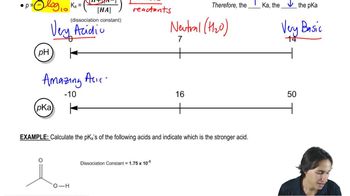
The pH scale vs. the pKa scale.

Hydronium Ion Concentration

The concentration of hydronium ions ([H3O+]) in a solution directly influences its pH. A higher concentration of H3O+ corresponds to a lower pH, indicating a more acidic solution. Conversely, a lower concentration results in a higher pH, indicating a more basic solution. This relationship is fundamental for both estimating and calculating pH values in various solutions.
Recommended video:
Guided course
3:39
Metal Ion Catalysis Concept 1

Logarithmic Relationships

The pH scale is logarithmic, meaning each whole number change on the scale represents a tenfold change in H3O+ concentration. For example, a solution with a pH of 3 has ten times more hydronium ions than a solution with a pH of 4. This concept is essential for understanding how small changes in ion concentration can significantly affect pH, which is critical for both estimation and precise calculation.
Recommended video:
02:56
Isomeric Relationships