

What is the product of an acyl substitution reaction—a new carboxylic acid derivative, a mixture of two carboxylic acid derivatives, or no reaction—if the new group in the tetrahedral intermediate is the following? b. a weaker base than the substituent that is attached to the acyl group
Ch. 15 - Reactions of Carboxylic Acids and Carboxylic Acid Derivatives
All textbooks
Bruice 8th Edition
Ch. 15 - Reactions of Carboxylic Acids and Carboxylic Acid Derivatives
Problem 10d
Bruice 8th Edition
Ch. 15 - Reactions of Carboxylic Acids and Carboxylic Acid Derivatives
Problem 10dChapter 15, Problem 10d
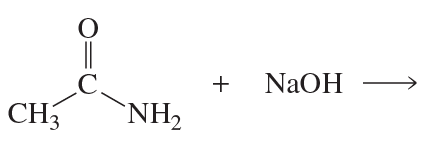
Using the pKa values listed in [TABLE 15.1], predict the products of the following reactions:
d. 
Verified step by step guidance1
Step 1: Identify the functional group in the given compound. The compound contains an amide functional group (-CONH2). Amides can undergo hydrolysis in the presence of a strong base like NaOH.
Step 2: Recall the mechanism of base-catalyzed hydrolysis of amides. In this reaction, the hydroxide ion (OH⁻) attacks the carbonyl carbon of the amide, leading to the cleavage of the C-N bond.
Step 3: Analyze the leaving group. The leaving group in this reaction is the amine (-NH2), which forms its conjugate acid, NH3, as shown in the table. The pKa of NH3 is 36, indicating it is a weak acid.
Step 4: Predict the products. The hydrolysis of the amide will yield a carboxylate ion (RCOO⁻) and ammonia (NH3). The carboxylate ion is formed because the reaction occurs under basic conditions, preventing the formation of the neutral carboxylic acid.
Step 5: Write the general reaction. The amide reacts with NaOH to produce a carboxylate salt (CH3CH2COO⁻Na⁺) and ammonia (NH3). This is consistent with the base-catalyzed hydrolysis mechanism.

Verified video answer for a similar problem:
This video solution was recommended by our tutors as helpful for the problem above.
Video duration:
5mWas this helpful?
Key Concepts
Here are the essential concepts you must grasp in order to answer the question correctly.
pKa and Acid Strength
pKa is a quantitative measure of the strength of an acid in solution; it indicates how easily an acid donates a proton (H+). Lower pKa values correspond to stronger acids, which are more likely to lose a proton. In nucleophilic acyl substitution reactions, the pKa of the leaving group’s conjugate acid is crucial for predicting the feasibility of the reaction, as a weaker acid (higher pKa) indicates a better leaving group.
Recommended video:
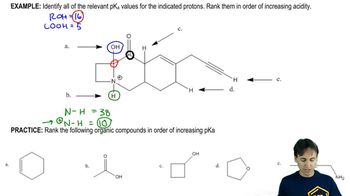
Identifying pKa values
Nucleophilic Acyl Substitution
Nucleophilic acyl substitution is a fundamental reaction in organic chemistry where a nucleophile attacks a carbonyl carbon, leading to the replacement of a leaving group. This reaction typically involves carboxylic acid derivatives, such as esters or anhydrides, and is influenced by the stability of the leaving group and the nucleophile's strength. Understanding this mechanism is essential for predicting the products of the reaction.
Recommended video:
Nucleophiles and Electrophiles can react in Substitution Reactions.
Leaving Groups
A leaving group is an atom or group that can depart from the parent molecule during a chemical reaction, taking with it the electrons that were shared with the parent. The ability of a leaving group to stabilize the negative charge after departure is critical; good leaving groups are typically weak bases (high pKa values for their conjugate acids). In the context of the provided reaction, the nature of the leaving group will significantly affect the reaction's outcome.
Recommended video:
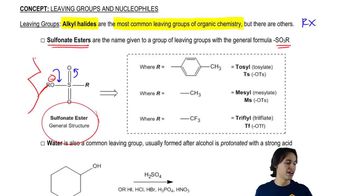
The 3 important leaving groups to know.
Related Practice
Textbook Question
955
views
Textbook Question
Starting with acetyl chloride, what neutral nucleophile would you use to synthesize each of the following compounds?
e.
1147
views
Textbook Question
What is the product of an acyl substitution reaction—a new carboxylic acid derivative, a mixture of two carboxylic acid derivatives, or no reaction—if the new group in the tetrahedral intermediate is the following? a. a stronger base than the substituent that is attached to the acyl group
1121
views
Textbook Question
Starting with acetyl chloride, what neutral nucleophile would you use to synthesize each of the following compounds?
c.
1037
views
Textbook Question
Starting with acetyl chloride, what neutral nucleophile would you use to synthesize each of the following compounds?
d.
1050
views
Textbook Question
Using the pKa values listed in [TABLE 15.1], predict the products of the following reactions:
c.
1356
views