

Ch.11 - Reactions of Alcohols
Wade - Organic Chemistry 9th Edition
Wade9th EditionOrganic ChemistryISBN: 9780135213728Not the one you use?Change textbook
Chapter 11, Problem 18


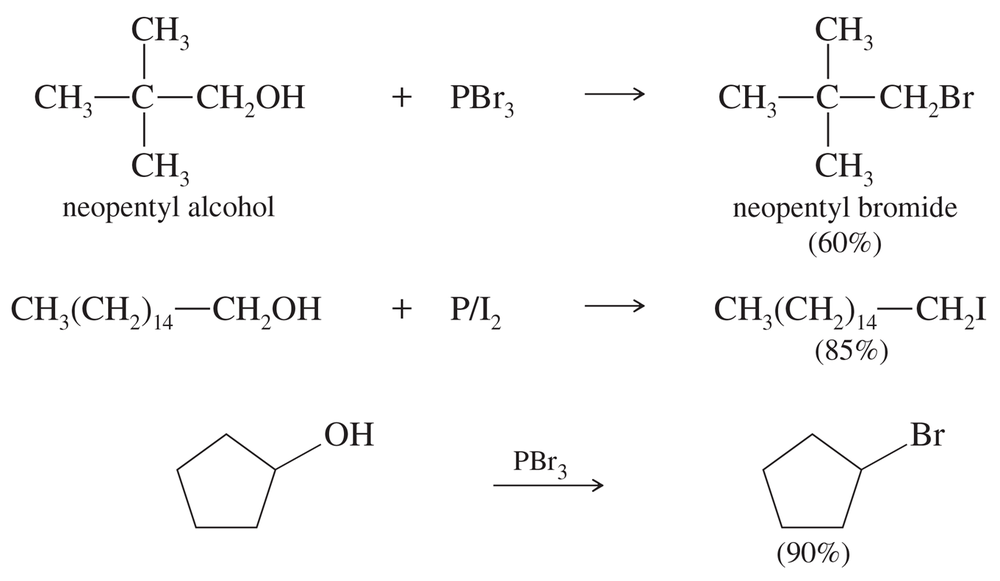
Write balanced equations for the three preceding reactions.

Verified step by step guidance
1
Step 1: Identify the type of reaction occurring in each case. These reactions involve the substitution of the hydroxyl group (-OH) in alcohols with halogens (Br or I) using reagents like PBr₃ or P/I₂.
Step 2: Write the general reaction for each case. For example, alcohol reacts with PBr₃ to form alkyl bromide and byproducts such as H₃PO₃. Similarly, alcohol reacts with P/I₂ to form alkyl iodide and byproducts.
Step 3: Balance the chemical equations. Ensure that the number of atoms of each element is the same on both sides of the equation. For instance, when using PBr₃, three molecules of alcohol react with one molecule of PBr₃ to produce three molecules of alkyl bromide and one molecule of H₃PO₃.
Step 4: Apply the balanced equations to the specific examples provided in the images. For example: (a) CH₃CH₂OH + PBr₃ → CH₃CH₂Br + H₃PO₃, (b) (CH₃)₂CHOH + P/I₂ → (CH₃)₂CHI + H₃PO₃, and (c) cyclohexanol + PBr₃ → cyclohexyl bromide + H₃PO₃.
Step 5: Verify the products formed in each reaction. The substitution reactions proceed with high yields as indicated in the images (e.g., 60%, 85%, 90%). Ensure the correct halogen is substituted based on the reagent used (Br for PBr₃ and I for P/I₂).

Verified video answer for a similar problem:

This video solution was recommended by our tutors as helpful for the problem above.
Video duration:
6m
Was this helpful?

Key Concepts

Here are the essential concepts you must grasp in order to answer the question correctly.

Nucleophilic Substitution Reactions

Nucleophilic substitution reactions involve the replacement of a leaving group in a molecule by a nucleophile. In the context of the reactions shown, the alcohol group (-OH) in neopentyl alcohol is replaced by bromine (Br) or iodine (I) through the action of phosphorus tribromide (PBr3) or iodine (I2), respectively. Understanding this mechanism is crucial for writing balanced equations for these transformations.
Recommended video:
Guided course
01:47
Nucleophiles and Electrophiles can react in Substitution Reactions.

Reagents in Organic Reactions

The choice of reagents significantly influences the outcome of organic reactions. In the provided reactions, PBr3 is used to convert alcohols to alkyl halides efficiently. This reagent facilitates the conversion by activating the alcohol for nucleophilic attack, leading to the formation of bromides. Recognizing the role of reagents helps in predicting the products and writing balanced equations.
Recommended video:
Guided course
02:17
Identifying organic molecules

Balancing Chemical Equations

Balancing chemical equations is essential for accurately representing the conservation of mass in a chemical reaction. Each side of the equation must have the same number of atoms for each element. In the context of the reactions shown, it is important to account for all reactants and products, including the stoichiometry of the reagents and the resulting alkyl halides, to ensure the equations are balanced correctly.
Recommended video:
3:11
Chemical Reactions of Phosphate Anhydrides Concept 1