Ch.10 - Structure and Synthesis of Alcohols
Wade - Organic Chemistry 9th Edition
Wade9th EditionOrganic ChemistryISBN: 9780135213728Not the one you use?Change textbook
Chapter 10, Problem 56c

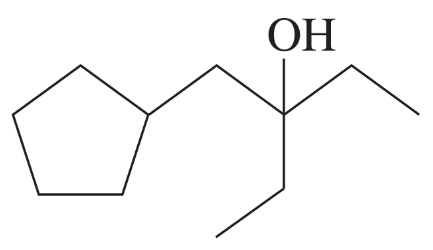
Often, compounds can be synthesized by more than one method. Show how this 3° alcohol can be made from the following:

(c) an ester

Verified step by step guidance
1
Step 1: Identify the target molecule, which is a tertiary alcohol. The structure provided shows a 3° alcohol with a cyclopentyl group, a methyl group, and an ethyl group attached to the central carbon bearing the hydroxyl group.
Step 2: To synthesize this tertiary alcohol from an ester, consider the reaction mechanism. Esters can be reduced to alcohols using organometallic reagents such as Grignard reagents (RMgX) or organolithium reagents (RLi). These reagents add alkyl groups to the carbonyl carbon of the ester.
Step 3: Select an appropriate ester precursor. The ester should have a structure that allows the formation of the tertiary alcohol upon reaction with the organometallic reagent. For this molecule, the ester could be ethyl cyclopentylcarboxylate (cyclopentyl group attached to the carbonyl carbon and an ethyl group as the ester substituent).
Step 4: React the ester with a methyl Grignard reagent (CH₃MgBr) or methyl lithium (CH₃Li). The organometallic reagent will attack the carbonyl carbon of the ester, leading to the formation of a tertiary alcohol after hydrolysis.
Step 5: Perform the hydrolysis step. After the addition of the organometallic reagent, the intermediate formed is a tertiary alkoxide. Acidic workup (e.g., H₃O⁺) will protonate the alkoxide, yielding the desired tertiary alcohol.

Verified video answer for a similar problem:

This video solution was recommended by our tutors as helpful for the problem above.
Video duration:
3m
Was this helpful?

Key Concepts

Here are the essential concepts you must grasp in order to answer the question correctly.

Alcohol Synthesis

Alcohols can be synthesized through various methods, including reduction of carbonyl compounds, hydrolysis of alkyl halides, and esterification reactions. Understanding the mechanisms of these reactions is crucial for determining how to convert other functional groups, such as esters, into alcohols.
Recommended video:
Guided course
02:26
Forming alcohols through Oxymercuration-Reduction.

Ester Hydrolysis

Ester hydrolysis is a reaction where an ester reacts with water to form an alcohol and a carboxylic acid. This reaction can occur under acidic or basic conditions and is essential for converting esters into alcohols, particularly in the context of synthesizing a tertiary alcohol from an ester.
Recommended video:
0:48
Hydrolysis of Phosphate Esters Concept 2

Tertiary Alcohols

Tertiary alcohols are characterized by having the hydroxyl (-OH) group attached to a carbon atom that is bonded to three other carbon atoms. Their synthesis often involves reactions that provide a stable carbocation intermediate, which is important when considering the pathways from esters to tertiary alcohols.
Recommended video:
2:07
Tertiary Protein Structure Concept 1