Ch. 4 - Isomers: The Arrangement of Atoms in Space
Bruice - Organic Chemistry 8th Edition
Bruice8th EditionOrganic ChemistryISBN: 9780135213711Not the one you use?Change textbook
Chapter 5, Problem 76c

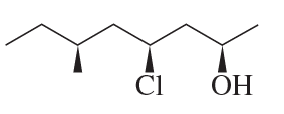
Name the following:
c. Structural formula showing a carbon chain with a chlorine (Cl) and hydroxyl (OH) group attached.

Verified step by step guidance
1
Step 1: Identify the longest continuous carbon chain in the structure. This will serve as the parent chain for naming the compound. Count the number of carbons in this chain to determine the base name (e.g., pentane, hexane, etc.).
Step 2: Identify and number the substituents on the parent chain. Start numbering from the end of the chain closest to the substituent with the highest priority according to IUPAC rules. In this case, the hydroxyl (-OH) group has higher priority than the bromine (Br) atom.
Step 3: Assign the configuration (R or S) to the chiral centers in the molecule. Use the Cahn-Ingold-Prelog priority rules to determine the stereochemistry of the chiral centers. The hydroxyl group and bromine atom are attached to chiral carbons, so their configurations need to be specified.
Step 4: Combine the information from the previous steps to construct the name. Include the stereochemistry (R/S) for each chiral center, the position of the substituents, and the name of the parent chain. Ensure the substituents are listed in alphabetical order.
Step 5: Double-check the name for accuracy, ensuring that all substituents, stereochemistry, and the parent chain are correctly represented according to IUPAC nomenclature rules.

Verified video answer for a similar problem:

This video solution was recommended by our tutors as helpful for the problem above.
Video duration:
8m
Was this helpful?

Key Concepts

Here are the essential concepts you must grasp in order to answer the question correctly.

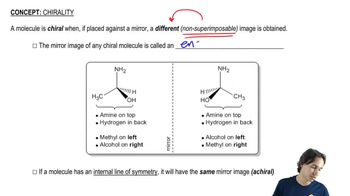
Chirality

Chirality refers to the geometric property of a molecule that makes it non-superimposable on its mirror image. This is often due to the presence of a chiral center, typically a carbon atom bonded to four different substituents. In the context of the provided structure, the presence of both an OH and a Br group on the chiral carbon indicates that the molecule can exist in two enantiomeric forms, R and S.
Recommended video:
Guided course
05:10
What is chirality?

R and S Configuration

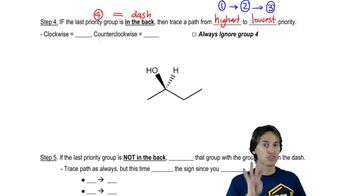
The R and S nomenclature is a system used to describe the absolute configuration of chiral centers in molecules. To assign R or S, the substituents attached to the chiral carbon are ranked according to their atomic number, with higher atomic numbers receiving higher priority. The configuration is determined by the spatial arrangement of these substituents when viewed from a specific perspective, which is crucial for understanding the molecule's stereochemistry.
Recommended video:
Guided course
03:07
R and S Naming- Step 4

Functional Groups

Functional groups are specific groups of atoms within molecules that are responsible for the characteristic chemical reactions of those molecules. In the given structure, the hydroxyl group (OH) and the bromine atom (Br) are functional groups that influence the molecule's reactivity and properties. Understanding these groups is essential for predicting how the molecule will behave in chemical reactions and its interactions with other substances.
Recommended video:
Guided course
02:36
Identifying Functional Groups