Ch.9 - Alkynes
Wade - Organic Chemistry 9th Edition
Wade9th EditionOrganic ChemistryISBN: 9780135213728Not the one you use?Change textbook
Chapter 9, Problem 34d

Show how you would accomplish the following synthetic transformations. Show all intermediates.
d. trans-hex-2-ene → hex-2-yne

Verified step by step guidance
1
Step 1: Begin with the starting material, trans-hex-2-ene. This is an alkene with a double bond between the second and third carbons in a trans configuration.
Step 2: Perform a halogenation reaction using Br2 or Cl2 in an inert solvent like CCl4. This will add two halogen atoms (e.g., bromine) across the double bond, forming 2,3-dibromohexane as the intermediate.
Step 3: Treat the 2,3-dibromohexane intermediate with a strong base, such as NaNH2 or KOH, under elimination conditions. The base will remove two equivalents of HX (e.g., HBr), resulting in the formation of a triple bond at the same position, yielding hex-2-yne.
Step 4: Ensure the reaction conditions are controlled to favor the formation of the alkyne rather than over-elimination or side reactions. Use excess base if necessary.
Step 5: Confirm the product structure, hex-2-yne, by analyzing its physical and spectroscopic properties, such as IR (showing a sharp alkyne stretch around 2100 cm⁻¹) or NMR (characteristic chemical shifts for the alkyne hydrogens).

Verified video answer for a similar problem:

This video solution was recommended by our tutors as helpful for the problem above.
Video duration:
9m

Key Concepts

Here are the essential concepts you must grasp in order to answer the question correctly.

Elimination Reactions

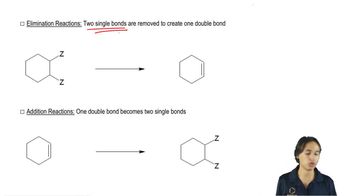
Elimination reactions involve the removal of atoms or groups from a molecule, resulting in the formation of a double or triple bond. In the transformation from trans-hex-2-ene to hex-2-yne, an elimination reaction is crucial to convert the alkene into an alkyne. Typically, this can be achieved through a dehydrohalogenation process, where a hydrogen halide is removed, leading to the formation of the desired triple bond.
Recommended video:
00:40
Recognizing Elimination Reactions.

Hydrohalogenation

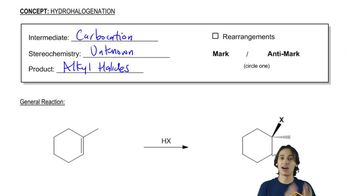
Hydrohalogenation is the addition of hydrogen halides (HX) to alkenes, which can be a key step in synthetic pathways. In the case of trans-hex-2-ene, hydrohalogenation can be used to introduce a halogen atom, creating a more reactive intermediate that can undergo further elimination to form the alkyne. Understanding regioselectivity and stereochemistry during this step is essential for predicting the correct product.
Recommended video:
04:07
General properties of hydrohalogenation.

Synthesis of Alkynes

The synthesis of alkynes often involves converting alkenes through a series of reactions, including elimination and rearrangement. In this transformation, the initial alkene (trans-hex-2-ene) can be converted to a vicinal dihalide, which can then undergo a double elimination to yield hex-2-yne. Familiarity with the mechanisms and conditions for these reactions is vital for successfully completing the synthesis.
Recommended video:
09:11
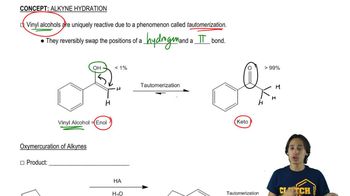
Alkyne Hydration