Ch. 3 - Trigonometric Identities and Equations
Blitzer - Trigonometry 3rd Edition
Blitzer3rd EditionTrigonometryISBN: 9780137316601Not the one you use?Change textbook
Chapter 3, Problem 3.3.42

In Exercises 39–46, use a half-angle formula to find the exact value of each expression. sin 105°

Verified step by step guidance
1
Recognize that 105° can be expressed as twice an angle, which allows the use of the half-angle formula. Since 105° = 2 × 52.5°, we can set \( \theta = 52.5^\circ \).
Recall the half-angle formula for sine: \[ \sin\left(\frac{\theta}{2}\right) = \pm \sqrt{\frac{1 - \cos(\theta)}{2}} \] Since we want \( \sin(105^\circ) = \sin(2 \times 52.5^\circ) \), we can rewrite it as \( \sin(105^\circ) = 2 \sin(52.5^\circ) \cos(52.5^\circ) \), but to use the half-angle formula directly, consider \( 105^\circ = 210^\circ / 2 \).
Alternatively, express 105° as half of 210°, so \( \theta = 210^\circ \). Then apply the half-angle formula: \[ \sin(105^\circ) = \sin\left(\frac{210^\circ}{2}\right) = \pm \sqrt{\frac{1 - \cos(210^\circ)}{2}} \]
Determine the sign of the sine value at 105°. Since 105° is in the second quadrant where sine is positive, choose the positive root.
Find \( \cos(210^\circ) \) using known values or the unit circle, then substitute into the half-angle formula: \[ \sin(105^\circ) = + \sqrt{\frac{1 - \cos(210^\circ)}{2}} \] This expression gives the exact value of \( \sin(105^\circ) \).

Verified video answer for a similar problem:

This video solution was recommended by our tutors as helpful for the problem above.
Video duration:
5m
Was this helpful?

Key Concepts

Here are the essential concepts you must grasp in order to answer the question correctly.

Half-Angle Formulas

Half-angle formulas express the sine, cosine, or tangent of half an angle in terms of the cosine of the original angle. For sine, the formula is sin(θ/2) = ±√[(1 - cos θ)/2], where the sign depends on the quadrant of θ/2. These formulas help find exact trigonometric values for angles not commonly found on the unit circle.
Recommended video:
6:36
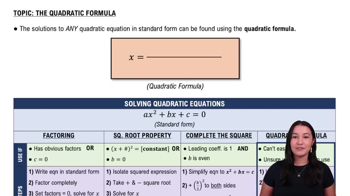
Quadratic Formula

Angle Decomposition

To use half-angle formulas effectively, the given angle must be expressed as twice another angle whose trigonometric values are known. For example, 105° can be written as 210°/2, allowing the use of the half-angle formula with θ = 210°. This step is crucial for applying the formula correctly.
Recommended video:
04:46
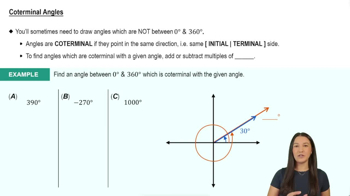
Coterminal Angles

Sign Determination Based on Quadrants

When applying half-angle formulas, determining the correct sign (positive or negative) of the result depends on the quadrant in which the half-angle lies. Since sin 105° is positive (second quadrant), the positive root is chosen. Understanding quadrant signs ensures the exact value reflects the correct trigonometric sign.
Recommended video:
6:36
Quadratic Formula