Solve each equation for exact solutions over the interval [0, 2π). tan² x + 3 = 0
Verified step by step guidance
1
Start with the given equation: \(\tan^{2} x + 3 = 0\).
Isolate the \(\tan^{2} x\) term by subtracting 3 from both sides: \(\tan^{2} x = -3\).
Recall that \(\tan^{2} x\) represents the square of the tangent function, which is always greater than or equal to zero for all real \(x\) because squaring any real number cannot produce a negative result.
Since \(\tan^{2} x = -3\) implies a negative value, recognize that there are no real values of \(x\) for which this equation holds true within the interval \([0, 2\pi)\).
Conclude that the equation has no exact solutions in the interval \([0, 2\pi)\) because the square of tangent cannot be negative.
Verified video answer for a similar problem:
This video solution was recommended by our tutors as helpful for the problem above
Play a video:
0 Comments
Key Concepts
Here are the essential concepts you must grasp in order to answer the question correctly.
Properties of the Tangent Function
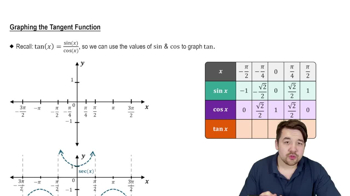
The tangent function, tan(x), is defined as sin(x)/cos(x) and has a period of π. It is undefined where cos(x) = 0, and its values can be positive or negative. Understanding its behavior and domain is essential when solving equations involving tan²(x).
Solving Quadratic Equations in Trigonometric Functions
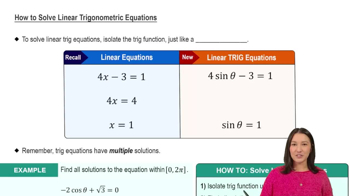
Equations like tan²(x) + 3 = 0 can be treated as quadratic in terms of tan(x). Solving involves isolating tan²(x) and checking for real solutions, considering that squares of real numbers are non-negative, which affects the existence of solutions.
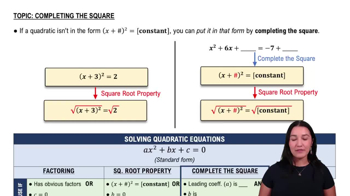
Solving Quadratic Equations by Completing the Square
Interval and Exact Solutions in Trigonometry
Finding exact solutions over [0, 2π) requires identifying all angles within one full rotation that satisfy the equation. Solutions must be expressed in exact form (like π/4), and understanding the periodicity and symmetry of trig functions helps determine all valid solutions.