Ch. 1 - Trigonometric Functions
Lial - Trigonometry 12th Edition
Lial12th EditionTrigonometryISBN: 9780136552161Not the one you use?Change textbook
Chapter 2, Problem 107

Concept Check Find a solution for each equation. sin(4θ + 2°) csc(3θ + 5°) = 1

Verified step by step guidance
1
Recall the identity that relates sine and cosecant: \(\csc x = \frac{1}{\sin x}\). Using this, rewrite the equation \(\sin(4\theta + 2^\circ) \cdot \csc(3\theta + 5^\circ) = 1\) as \(\sin(4\theta + 2^\circ) \cdot \frac{1}{\sin(3\theta + 5^\circ)} = 1\).
Simplify the equation to get \(\frac{\sin(4\theta + 2^\circ)}{\sin(3\theta + 5^\circ)} = 1\).
From the simplified equation, deduce that \(\sin(4\theta + 2^\circ) = \sin(3\theta + 5^\circ)\).
Use the general solution for when two sine values are equal: \(\sin A = \sin B\) implies \(A = B + 360^\circ k\) or \(A = 180^\circ - B + 360^\circ k\), where \(k\) is any integer.
Set up the two equations based on the above and solve for \(\theta\) in each case: 1) \(4\theta + 2^\circ = 3\theta + 5^\circ + 360^\circ k\) 2) \(4\theta + 2^\circ = 180^\circ - (3\theta + 5^\circ) + 360^\circ k\). Then isolate \(\theta\) in each equation to find the general solutions.

Verified video answer for a similar problem:

This video solution was recommended by our tutors as helpful for the problem above.
Video duration:
3m

Key Concepts

Here are the essential concepts you must grasp in order to answer the question correctly.

Relationship Between Sine and Cosecant

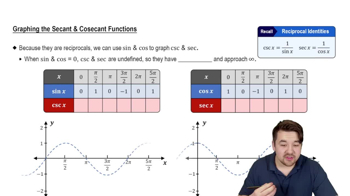
Cosecant is the reciprocal of sine, meaning csc(x) = 1/sin(x). Understanding this relationship allows you to rewrite the equation sin(A) * csc(B) = 1 as sin(A) / sin(B) = 1, which simplifies the problem and helps in finding solutions for the angles involved.
Recommended video:
6:22
Graphs of Secant and Cosecant Functions

Solving Trigonometric Equations

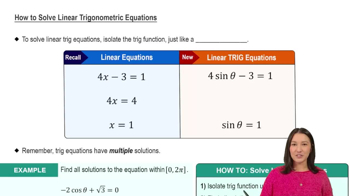
Solving trigonometric equations involves isolating the trigonometric function and finding all angle values that satisfy the equation within a given domain. This often requires using identities, inverse functions, and considering the periodic nature of sine and cosecant to find general solutions.
Recommended video:
4:34
How to Solve Linear Trigonometric Equations

Angle Measures and Periodicity

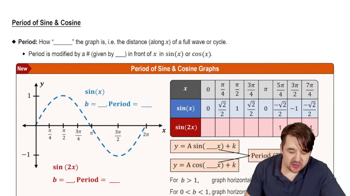
Trigonometric functions are periodic, meaning their values repeat at regular intervals (360° for sine and cosecant). When solving equations like sin(4θ + 2°) = sin(3θ + 5°), it is essential to consider all possible angles by adding integer multiples of the period to find the complete set of solutions.
Recommended video:
5:33
Period of Sine and Cosine Functions