In Exercises 9–16, solve each triangle. Round lengths to the nearest tenth and angle measures to the nearest degree.B = 80°, C = 10°, a = 8
Verified step by step guidance
1
insert step 1: Start by determining the measure of angle A. Since the sum of angles in a triangle is 180°, use the equation A + B + C = 180° to find A.
insert step 2: Substitute the given angles B = 80° and C = 10° into the equation to solve for A.
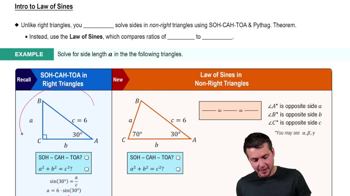
insert step 3: Use the Law of Sines to find the length of side b. The Law of Sines states that \( \frac{a}{\sin A} = \frac{b}{\sin B} \).
insert step 4: Substitute the known values into the Law of Sines equation: \( \frac{8}{\sin A} = \frac{b}{\sin 80°} \).
insert step 5: Use the Law of Sines again to find the length of side c. The equation is \( \frac{a}{\sin A} = \frac{c}{\sin C} \). Substitute the known values: \( \frac{8}{\sin A} = \frac{c}{\sin 10°} \).
Verified video answer for a similar problem:
This video solution was recommended by our tutors as helpful for the problem above
Video duration:
5m
Play a video:
0 Comments
Key Concepts
Here are the essential concepts you must grasp in order to answer the question correctly.
Law of Sines
The Law of Sines is a fundamental principle in trigonometry that relates the ratios of the lengths of sides of a triangle to the sines of its angles. It states that for any triangle, the ratio of a side length to the sine of its opposite angle is constant. This law is particularly useful for solving triangles when given two angles and one side (AAS or ASA) or two sides and a non-included angle (SSA).
The Triangle Sum Theorem states that the sum of the interior angles of a triangle is always 180 degrees. This theorem is essential for finding unknown angles in a triangle when two angles are known. In the given problem, knowing angles B and C allows us to calculate angle A, which is crucial for applying the Law of Sines effectively.
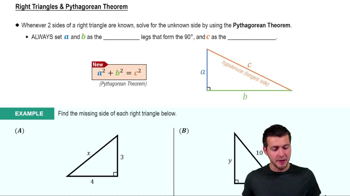
Solving Right Triangles with the Pythagorean Theorem
Rounding in Trigonometry
Rounding is an important aspect of solving trigonometric problems, especially when dealing with measurements. In this context, lengths are rounded to the nearest tenth and angle measures to the nearest degree. Understanding how to round correctly ensures that the final answers are presented in a clear and precise manner, which is essential for accurate communication of results in mathematics.