
Ch. 6 - Inverse Circular Functions and Trigonometric Equations
Lial - Trigonometry 12th Edition
Lial12th EditionTrigonometryISBN: 9780136552161Not the one you use?Change textbook
Chapter 7, Problem 6.3.25

Solve each equation in x over the interval [0, 2π) and each equation in θ over the interval [0°, 360°). Give exact solutions.
sin (x/2) = √2 ― sin (x/2)

Verified step by step guidance
1
Start by rewriting the given equation: \(\sin\left(\frac{x}{2}\right) = \sqrt{2} - \sin\left(\frac{x}{2}\right)\).
Add \(\sin\left(\frac{x}{2}\right)\) to both sides to combine like terms: \(\sin\left(\frac{x}{2}\right) + \sin\left(\frac{x}{2}\right) = \sqrt{2}\), which simplifies to \(2 \sin\left(\frac{x}{2}\right) = \sqrt{2}\).
Divide both sides by 2 to isolate the sine term: \(\sin\left(\frac{x}{2}\right) = \frac{\sqrt{2}}{2}\).
Recall that \(\sin(\alpha) = \frac{\sqrt{2}}{2}\) at angles \(\alpha = \frac{\pi}{4}\) and \(\alpha = \frac{3\pi}{4}\) within the interval \([0, 2\pi)\), and similarly for degrees \(45^\circ\) and \(135^\circ\) within \([0^\circ, 360^\circ)\).
Set \(\frac{x}{2} = \frac{\pi}{4}\) and \(\frac{x}{2} = \frac{3\pi}{4}\) (or \(\frac{x}{2} = 45^\circ\) and \(\frac{x}{2} = 135^\circ\)), then solve for \(x\) (or \(\theta\)) by multiplying both sides by 2. Make sure to check that the solutions lie within the original intervals \([0, 2\pi)\) for \(x\) and \([0^\circ, 360^\circ)\) for \(\theta\).

Verified video answer for a similar problem:

This video solution was recommended by our tutors as helpful for the problem above.
Was this helpful?

Key Concepts

Here are the essential concepts you must grasp in order to answer the question correctly.

Solving Trigonometric Equations

Solving trigonometric equations involves isolating the trigonometric function and finding all angle values within a specified interval that satisfy the equation. This often requires algebraic manipulation and using known values or identities to simplify the equation.
Recommended video:
4:34
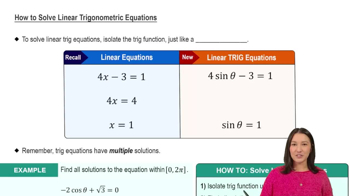
How to Solve Linear Trigonometric Equations

Properties of the Sine Function

The sine function is periodic with period 2π and has a range of [-1, 1]. Understanding its symmetry and key values at standard angles helps in finding exact solutions. For example, sin(θ) = sin(π - θ) and sin(θ) = sin(θ + 2πk) for any integer k.
Recommended video:
5:53
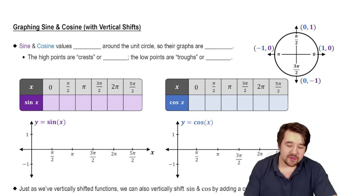
Graph of Sine and Cosine Function

Interval Notation and Angle Measurement

The problem specifies solutions over intervals [0, 2π) for radians and [0°, 360°) for degrees. Knowing how to convert between radians and degrees and restricting solutions to these intervals ensures all valid solutions are found without repetition.
Recommended video:
06:01
i & j Notation