Ch. 7 - Applications of Trigonometry and Vectors
Lial - Trigonometry 12th Edition
Lial12th EditionTrigonometryISBN: 9780136552161Not the one you use?Change textbook
Chapter 8, Problem 18

Vector v has the given direction angle and magnitude. Find the horizontal and vertical components.
θ = 27° 30' |v| = 15.4

Verified step by step guidance
1
Convert the direction angle from degrees and minutes to decimal degrees. Since 1 minute is \( \frac{1}{60} \) of a degree, calculate \( 27^\circ 30' = 27 + \frac{30}{60} = 27.5^\circ \).
Recall that the horizontal component (\( v_x \)) of a vector is found by multiplying the magnitude by the cosine of the direction angle: \( v_x = |v| \cdot \cos(\theta) \).
Similarly, the vertical component (\( v_y \)) is found by multiplying the magnitude by the sine of the direction angle: \( v_y = |v| \cdot \sin(\theta) \).
Substitute the given magnitude \( |v| = 15.4 \) and the converted angle \( \theta = 27.5^\circ \) into the formulas: \( v_x = 15.4 \cdot \cos(27.5^\circ) \) and \( v_y = 15.4 \cdot \sin(27.5^\circ) \).
Use a calculator set to degree mode to evaluate the cosine and sine values, then multiply to find the horizontal and vertical components of the vector.

Verified video answer for a similar problem:

This video solution was recommended by our tutors as helpful for the problem above.
Was this helpful?

Key Concepts

Here are the essential concepts you must grasp in order to answer the question correctly.

Direction Angle in Vectors

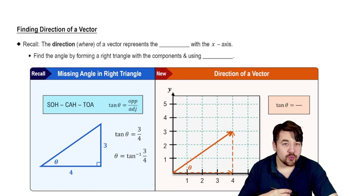
The direction angle of a vector is the angle it makes with the positive x-axis, measured counterclockwise. It determines the vector's orientation in the plane and is essential for decomposing the vector into components along the horizontal and vertical axes.
Recommended video:
05:13
Finding Direction of a Vector

Vector Magnitude

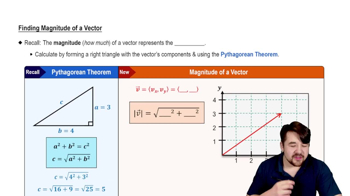
The magnitude of a vector represents its length or size. It is a scalar quantity that, combined with the direction angle, fully describes the vector. Knowing the magnitude allows calculation of the vector's components using trigonometric functions.
Recommended video:
04:44
Finding Magnitude of a Vector

Resolving Vectors into Components

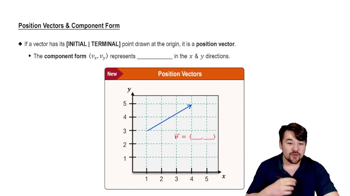
A vector can be broken down into horizontal (x) and vertical (y) components using trigonometry. The horizontal component is found by multiplying the magnitude by the cosine of the direction angle, and the vertical component by the sine of the angle, enabling easier analysis and computation.
Recommended video:
03:55
Position Vectors & Component Form