Ch. 5 - Trigonometric Identities
Lial - Trigonometry 12th Edition
Lial12th EditionTrigonometryISBN: 9780136552161Not the one you use?Change textbook
Chapter 6, Problem 5.6.12

Use a half-angle identity to find each exact value.
sin 195°

Verified step by step guidance
1
Recognize that 195° is not a standard angle, but it can be expressed in terms of an angle whose sine or cosine is known. Notice that 195° = 2 × 97.5°, so we can use the half-angle identity for sine by setting \( \theta = 195° \) and \( \frac{\theta}{2} = 97.5° \). However, since 97.5° is not a standard angle either, let's try to express 195° as \( 180° + 15° \) to use angle sum identities or consider the half-angle identity for \( 195° = 2 \times 97.5° \). Alternatively, use the half-angle identity with \( \theta = 390° \) because \( 195° = \frac{390°}{2} \).
Recall the half-angle identity for sine: \[ \sin\left(\frac{\alpha}{2}\right) = \pm \sqrt{\frac{1 - \cos(\alpha)}{2}} \] Here, \( \alpha = 390° \) so that \( \sin(195°) = \sin\left(\frac{390°}{2}\right) \).
Determine the sign of \( \sin(195°) \). Since 195° is in the third quadrant (between 180° and 270°), and sine is negative in the third quadrant, the sign will be negative.
Calculate \( \cos(390°) \). Since 390° is coterminal with 30° (because 390° - 360° = 30°), \( \cos(390°) = \cos(30°) \). Use the known exact value \( \cos(30°) = \frac{\sqrt{3}}{2} \).
Substitute \( \cos(390°) = \frac{\sqrt{3}}{2} \) into the half-angle formula and include the negative sign determined earlier: \[ \sin(195°) = - \sqrt{\frac{1 - \frac{\sqrt{3}}{2}}{2}} \] This expression represents the exact value of \( \sin(195°) \).

Verified video answer for a similar problem:

This video solution was recommended by our tutors as helpful for the problem above.
Was this helpful?

Key Concepts

Here are the essential concepts you must grasp in order to answer the question correctly.

Half-Angle Identities

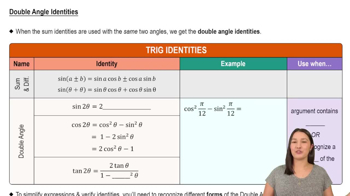
Half-angle identities express the sine, cosine, or tangent of half an angle in terms of the cosine of the original angle. For sine, the identity is sin(θ/2) = ±√[(1 - cos θ)/2]. The sign depends on the quadrant of θ/2. These identities help find exact trigonometric values for angles not commonly found on the unit circle.
Recommended video:
05:06
Double Angle Identities

Reference Angles and Quadrants

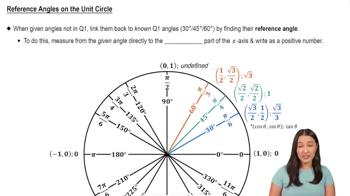
Understanding the quadrant in which an angle lies is crucial for determining the sign of trigonometric values. Since 195° is in the third quadrant, and half of 195° is 97.5°, which lies in the second quadrant, sine is positive there. Reference angles help relate unfamiliar angles to known values for easier calculation.
Recommended video:
5:31
Reference Angles on the Unit Circle

Exact Values of Cosine for Special Angles

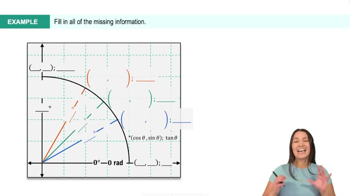
To use the half-angle identity, you need the exact value of cos(θ) for the original angle. For θ = 390° (since 195° = 390°/2), you simplify using periodicity (cos 390° = cos 30°). Knowing exact cosine values for special angles like 30°, 45°, and 60° is essential for precise calculations without a calculator.
Recommended video:
6:04
Example 1