Ch. 4 - Graphs of the Circular Functions
Lial - Trigonometry 12th Edition
Lial12th EditionTrigonometryISBN: 9780136552161Not the one you use?Change textbook
Chapter 5, Problem 27

Graph each function over a two-period interval.
y = cot (3x + π/4)

Verified step by step guidance
1
Identify the given function: \(y = \cot(3x + \frac{\pi}{4})\).
Recall that the cotangent function \(\cot(\theta)\) has a fundamental period of \(\pi\). For the function \(y = \cot(bx + c)\), the period is given by \(\frac{\pi}{|b|}\). Here, \(b = 3\), so the period is \(\frac{\pi}{3}\).
Since the problem asks to graph over a two-period interval, calculate the length of this interval as \(2 \times \frac{\pi}{3} = \frac{2\pi}{3}\).
Determine the starting and ending points of the interval. Because of the phase shift \(\frac{\pi}{4}\) inside the argument, solve for \(x\) when the argument goes from \(-\frac{\pi}{4}\) to \(-\frac{\pi}{4} + \frac{2\pi}{3}\) to cover two periods.
Plot key points within this interval by finding where the cotangent function has vertical asymptotes (where the argument equals multiples of \(\pi\)) and zeros (where the argument equals \(\frac{\pi}{2} + k\pi\)), then sketch the curve accordingly.

Verified video answer for a similar problem:

This video solution was recommended by our tutors as helpful for the problem above.
Was this helpful?

Key Concepts

Here are the essential concepts you must grasp in order to answer the question correctly.

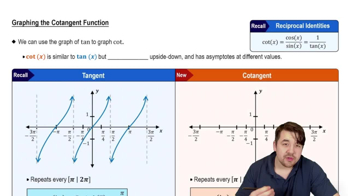
Cotangent Function and Its Properties

The cotangent function, cot(x), is the reciprocal of the tangent function and is periodic with period π. It has vertical asymptotes where the sine function is zero, causing the function to be undefined. Understanding its shape, zeros, and asymptotes is essential for accurate graphing.
Recommended video:
5:37
Introduction to Cotangent Graph

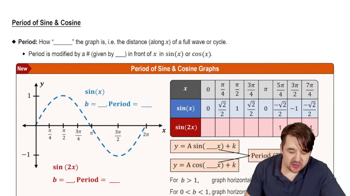
Period of a Trigonometric Function with Horizontal Scaling

When the input of a trigonometric function is multiplied by a constant (e.g., 3x), the period changes. The new period is the original period divided by the absolute value of the coefficient. For cot(3x + π/4), the period is π/3, which affects the interval over which the function repeats.
Recommended video:
5:33
Period of Sine and Cosine Functions

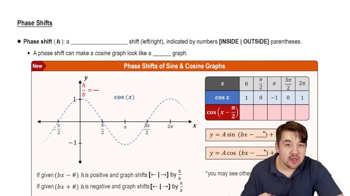
Phase Shift in Trigonometric Functions

The phase shift is the horizontal translation of the graph caused by adding or subtracting a constant inside the function's argument. For cot(3x + π/4), the phase shift is found by solving 3x + π/4 = 0, resulting in a shift of -π/12. This shift moves the graph left or right along the x-axis.
Recommended video:
6:31
Phase Shifts