Ch. 1 - Angles and the Trigonometric Functions
Blitzer - Trigonometry 3rd Edition
Blitzer3rd EditionTrigonometryISBN: 9780137316601Not the one you use?Change textbook
Chapter 1, Problem 6

In Exercises 5–7, convert each angle in radians to degrees. 7πœ‹ 5

Verified step by step guidance
1
Recall the formula to convert an angle from radians to degrees: \(\text{Degrees} = \text{Radians} \times \frac{180}{\pi}\).
Identify the given angle in radians, which is \(\frac{7\pi}{5}\).
Substitute the given radian measure into the conversion formula: \(\frac{7\pi}{5} \times \frac{180}{\pi}\).
Simplify the expression by canceling out \(\pi\) in the numerator and denominator: \(\frac{7 \times 180}{5}\).
Perform the multiplication and division to find the angle in degrees (this is the final calculation step you can do on your own).

Verified video answer for a similar problem:

This video solution was recommended by our tutors as helpful for the problem above.
Video duration:
1m
Was this helpful?

Key Concepts

Here are the essential concepts you must grasp in order to answer the question correctly.

Radian Measure

A radian is a unit of angular measure based on the radius of a circle. One radian is the angle subtended at the center of a circle by an arc equal in length to the radius. Understanding radians is essential because many trigonometric functions use radians as their standard input.
Recommended video:
5:04
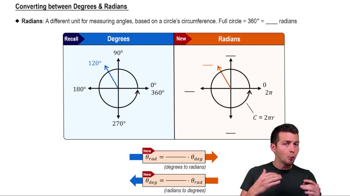
Converting between Degrees & Radians

Degree Measure

Degrees are a common unit for measuring angles, where a full circle is divided into 360 equal parts. Converting radians to degrees involves understanding that 360 degrees correspond to 2Ο€ radians, which allows for conversion between these two units.
Recommended video:
5:04
Converting between Degrees & Radians

Conversion Formula Between Radians and Degrees

To convert radians to degrees, multiply the radian measure by 180/Ο€. This formula comes from the equivalence of 2Ο€ radians to 360 degrees. Applying this formula to the given angle 7Ο€/5 will yield its degree measure.
Recommended video:
5:04
Converting between Degrees & Radians
Related Practice
Textbook Question

In Exercises 7–12, find the radian measure of the central angle of a circle of radius r that intercepts an arc of length s. Radius, r: 10 inches Arc Length, s: 40 inches

1042
views
Textbook Question

In Exercises 5–18, the unit circle has been divided into twelve equal arcs, corresponding to t-values of 0, πœ‹, πœ‹, πœ‹, 2πœ‹, 5πœ‹, πœ‹, 7πœ‹, 4πœ‹, 3πœ‹, 5πœ‹, 11πœ‹, and 2πœ‹. 6 3 2 3 6 6 3 2 3 6 Use the (x,y) coordinates in the figure to find the value of each trigonometric function at the indicated real number, t, or state that the expression is undefined. sin πœ‹/3

789
views
Textbook Question

The unit circle has been divided into twelve equal arcs, corresponding to t-values of


0, πœ‹/6, πœ‹/3, πœ‹/2, 2πœ‹/3, 5πœ‹/6, πœ‹, 7πœ‹/6, 4πœ‹/3, 3πœ‹/2, 5πœ‹/3, 11πœ‹/6, and 2πœ‹


Use the (x,y) coordinates in the figure to find the value of each trigonometric function at the indicated real number, t, or state that the expression is undefined.

<IMAGE>


sin πœ‹/6

445
views
Textbook Question

In Exercises 5–7, convert each angle in radians to degrees. 5πœ‹ 3

590
views
Textbook Question

In Exercises 1–6, the measure of an angle is given. Classify the angle as acute, right, obtuse, or straight. πœ‹/2

742
views
Textbook Question

In Exercises 1–8, a point on the terminal side of angle ΞΈ is given. Find the exact value of each of the six trigonometric functions of ΞΈ. (5, -5)

509
views