
Textbook Question
Verify that each equation is an identity.
sin³ θ = sin θ - cos² θ sin θ
795
views

 Verified step by step guidance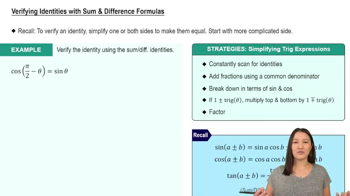
 2:25
2:25
 5:31
5:31 5:53
5:53Verify that each equation is an identity.
sin³ θ = sin θ - cos² θ sin θ
Advanced methods of trigonometry can be used to find the following exact value.
sin 18° = (√5 - 1)/4
(See Hobson's A Treatise on Plane Trigonometry.) Use this value and identities to find each exact value. Support answers with calculator approximations if desired.
cot 18°
Advanced methods of trigonometry can be used to find the following exact value.
sin 18° = (√5 - 1)/4
(See Hobson's A Treatise on Plane Trigonometry.) Use this value and identities to find each exact value. Support answers with calculator approximations if desired.
cos 18°
Verify that each equation is an identity.
2 cos² (x/2) tan x = tan x+ sin x
Verify that each equation is an identity.
sin(s + t)/cos s cot t = tan s + tan t
Verify that each equation is an identity (Hint: cos 2x = cos(x + x).)
cos( π/2 + x) = -sin x