Ch. 1 - Angles and the Trigonometric Functions
Blitzer - Trigonometry 3rd Edition
Blitzer3rd EditionTrigonometryISBN: 9780137316601Not the one you use?Change textbook
Chapter 1, Problem 11

In Exercises 5–18, the unit circle has been divided into twelve equal arcs, corresponding to t-values of


0, πœ‹, πœ‹, πœ‹, 2πœ‹, 5πœ‹, πœ‹, 7πœ‹, 4πœ‹, 3πœ‹, 5πœ‹, 11πœ‹, and 2πœ‹.
6 3 2 3 6 6 3 2 3 6


Use the (x,y) coordinates in the figure to find the value of each trigonometric function at the indicated real number, t, or state that the expression is undefined.
<IMAGE>


In Exercises 11–18, continue to refer to the figure at the bottom of the previous page.
csc 7πœ‹/6

Verified step by step guidance
1
Identify the angle given: \(t = \frac{7\pi}{6}\). This angle is in radians and corresponds to a point on the unit circle.
Recall that the cosecant function is the reciprocal of the sine function, so \(\csc t = \frac{1}{\sin t}\).
Locate the coordinates of the point on the unit circle corresponding to \(t = \frac{7\pi}{6}\). The coordinates are \((x, y) = (\cos t, \sin t)\).
Find the \(y\)-coordinate (which is \(\sin \frac{7\pi}{6}\)) from the unit circle. This value will be used to calculate \(\csc \frac{7\pi}{6}\).
Calculate \(\csc \frac{7\pi}{6}\) by taking the reciprocal of \(\sin \frac{7\pi}{6}\), i.e., \(\csc \frac{7\pi}{6} = \frac{1}{\sin \frac{7\pi}{6}}\). If \(\sin \frac{7\pi}{6} = 0\), then \(\csc \frac{7\pi}{6}\) is undefined.

Verified video answer for a similar problem:

This video solution was recommended by our tutors as helpful for the problem above.
Video duration:
3m
Was this helpful?

Key Concepts

Here are the essential concepts you must grasp in order to answer the question correctly.

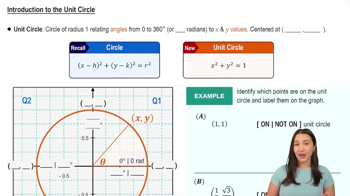
Unit Circle and Radian Measure

The unit circle is a circle with radius 1 centered at the origin of the coordinate plane. Angles on the unit circle are measured in radians, where one full rotation equals 2Ο€ radians. Understanding how to locate an angle t on the unit circle is essential for determining the corresponding coordinates (x, y) that represent cosine and sine values.
Recommended video:
06:11
Introduction to the Unit Circle

Trigonometric Functions and Their Coordinates

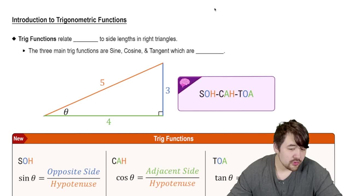
On the unit circle, the x-coordinate corresponds to cos(t) and the y-coordinate corresponds to sin(t). Other trigonometric functions like cosecant (csc t) are defined in terms of sine, with csc t = 1/sin t. Knowing how to use the coordinates to find these values is crucial, especially to identify when functions are undefined (e.g., when sin t = 0).
Recommended video:
6:04
Introduction to Trigonometric Functions

Evaluating Trigonometric Functions at Specific Angles

To evaluate functions like csc(7Ο€/6), first locate the angle 7Ο€/6 on the unit circle, find the sine value from the y-coordinate, and then compute the reciprocal for cosecant. Recognizing common reference angles and their sine values helps simplify this process and determine if the function is defined or undefined.
Recommended video:
3:48
Evaluate Composite Functions - Special Cases