Ch. 1 - Angles and the Trigonometric Functions
Blitzer - Trigonometry 3rd Edition
Blitzer3rd EditionTrigonometryISBN: 9780137316601Not the one you use?Change textbook
Chapter 1, Problem 12

Use the given triangles to evaluate each expression. If necessary, express the value without a square root in the denominator by rationalizing the denominator.


<IMAGE>


csc 45°

Verified step by step guidance
1
Recall the definition of cosecant: \(\csc \theta = \frac{1}{\sin \theta}\).
Identify the value of \(\sin 45^\circ\). Since \(45^\circ\) is a special angle, \(\sin 45^\circ = \frac{\sqrt{2}}{2}\).
Substitute \(\sin 45^\circ\) into the cosecant formula: \(\csc 45^\circ = \frac{1}{\frac{\sqrt{2}}{2}}\).
Simplify the fraction by multiplying numerator and denominator appropriately: \(\csc 45^\circ = \frac{1}{\frac{\sqrt{2}}{2}} = \frac{2}{\sqrt{2}}\).
Rationalize the denominator by multiplying numerator and denominator by \(\sqrt{2}\): \(\csc 45^\circ = \frac{2}{\sqrt{2}} \times \frac{\sqrt{2}}{\sqrt{2}} = \frac{2\sqrt{2}}{2}\), then simplify the fraction.

Verified video answer for a similar problem:

This video solution was recommended by our tutors as helpful for the problem above.
Video duration:
2m
Was this helpful?

Key Concepts

Here are the essential concepts you must grasp in order to answer the question correctly.

Definition of Cosecant (csc)

Cosecant is the reciprocal of sine, defined as csc θ = 1/sin θ. For an angle in a right triangle, it equals the ratio of the hypotenuse to the opposite side. Understanding this helps in evaluating csc 45° using known sine values.
Recommended video:
6:22
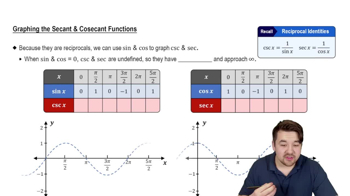
Graphs of Secant and Cosecant Functions

Special Angles and Their Trigonometric Values

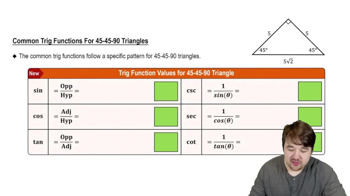
Angles like 45° have well-known sine and cosine values derived from special right triangles (e.g., isosceles right triangle). For 45°, sin 45° = √2/2, which simplifies calculations of trigonometric functions such as cosecant.
Recommended video:
3:28
Common Trig Functions For 45-45-90 Triangles

Rationalizing the Denominator

Rationalizing the denominator involves eliminating square roots from the denominator of a fraction by multiplying numerator and denominator by a suitable radical. This process simplifies expressions and is often required for final answers in trigonometry.
Recommended video:
2:58
Rationalizing Denominators
Related Practice
Textbook Question

In Exercises 7–12, find the radian measure of the central angle of a circle of radius r that intercepts an arc of length s. Radius, r: 1 meter Arc Length, s: 600 centimeters

585
views
Textbook Question

In Exercises 5–18, the unit circle has been divided into twelve equal arcs, corresponding to t-values of


0, 𝜋, 𝜋, 𝜋, 2𝜋, 5𝜋, 𝜋, 7𝜋, 4𝜋, 3𝜋, 5𝜋, 11𝜋, and 2𝜋.

6 3 2 3 6 6 3 2 3 6


Use the (x,y) coordinates in the figure to find the value of each trigonometric function at the indicated real number, t, or state that the expression is undefined.

<IMAGE>


In Exercises 11–18, continue to refer to the figure at the bottom of the previous page.

csc 7𝜋/6

414
views
Textbook Question

In Exercises 5–18, the unit circle has been divided into twelve equal arcs, corresponding to t-values of 0, 𝜋, 𝜋, 𝜋, 2𝜋, 5𝜋, 𝜋, 7𝜋, 4𝜋, 3𝜋, 5𝜋, 11𝜋, and 2𝜋. 6 3 2 3 6 6 3 2 3 6 Use the (x,y) coordinates in the figure to find the value of each trigonometric function at the indicated real number, t, or state that the expression is undefined.

In Exercises 11–18, continue to refer to the figure at the bottom of the previous page. csc 4𝜋/3

1150
views
Textbook Question

In Exercises 9–16, evaluate the trigonometric function at the quadrantal angle, or state that the expression is undefined. csc 𝜋

578
views
Textbook Question

In Exercises 8–12, draw each angle in standard position. -135°

798
views
Textbook Question

In Exercises 8–13, find the exact value of each expression. Do not use a calculator. cot (-8𝜋/3)

669
views