In Exercises 29–51, find the exact value of each expression. Do not use a calculator. tan [cos⁻¹ (− 4/5)]
Ch. 2 - Graphs of the Trigonometric Functions; Inverse Trigonometric Functions

All textbooks
Blitzer 3rd Edition
Ch. 2 - Graphs of the Trigonometric Functions; Inverse Trigonometric Functions
Problem 45
Blitzer 3rd Edition
Ch. 2 - Graphs of the Trigonometric Functions; Inverse Trigonometric Functions
Problem 45Chapter 2, Problem 45
In Exercises 29–51, find the exact value of each expression. Do not use a calculator. sin(cos⁻¹ 3/5)
Verified step by step guidance1
Recognize that the expression is \( \sin(\cos^{-1}(\frac{3}{5})) \). Here, \( \cos^{-1}(\frac{3}{5}) \) represents an angle \( \theta \) such that \( \cos(\theta) = \frac{3}{5} \).
Visualize or draw a right triangle where the adjacent side to angle \( \theta \) is 3 and the hypotenuse is 5, based on the cosine ratio \( \cos(\theta) = \frac{\text{adjacent}}{\text{hypotenuse}} \).
Use the Pythagorean theorem to find the length of the opposite side: \( \text{opposite} = \sqrt{5^2 - 3^2} = \sqrt{25 - 9} \).
Simplify the expression under the square root to find the opposite side length: \( \sqrt{16} \).
Calculate \( \sin(\theta) = \frac{\text{opposite}}{\text{hypotenuse}} = \frac{\sqrt{16}}{5} \), which gives the exact value of \( \sin(\cos^{-1}(\frac{3}{5})) \).

Verified video answer for a similar problem:
This video solution was recommended by our tutors as helpful for the problem above.
Video duration:
3mKey Concepts
Here are the essential concepts you must grasp in order to answer the question correctly.
Inverse Trigonometric Functions
Inverse trigonometric functions, like cos⁻¹(x), return the angle whose trigonometric ratio equals x. For example, cos⁻¹(3/5) gives the angle θ such that cos(θ) = 3/5. Understanding this allows us to interpret expressions involving inverse functions as angles.
Recommended video:
Guided course
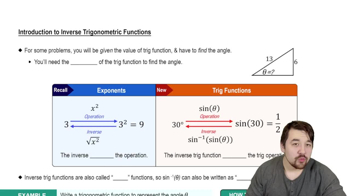
Introduction to Inverse Trig Functions
Right Triangle Relationships
Using the value of cos(θ) = adjacent/hypotenuse, we can construct a right triangle with sides 3 (adjacent) and 5 (hypotenuse). The Pythagorean theorem helps find the opposite side, enabling us to find sin(θ) based on triangle side ratios.
Recommended video:
Guided course
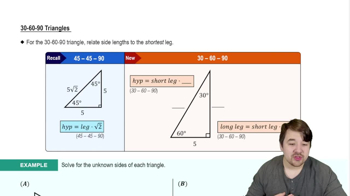
30-60-90 Triangles
Pythagorean Identity
The Pythagorean identity states sin²(θ) + cos²(θ) = 1. Given cos(θ), we can find sin(θ) by rearranging to sin(θ) = ±√(1 - cos²(θ)). This identity is essential for finding the sine of an angle when only the cosine is known.
Recommended video:
Guided course
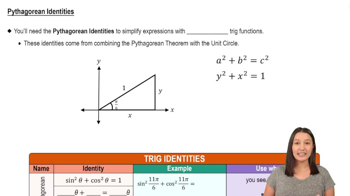
Pythagorean Identities
Related Practice
Textbook Question
786
views
Textbook Question
In Exercises 43–52, determine the amplitude, period, and phase shift of each function. Then graph one period of the function. y = 3 cos(2x − π)
572
views
Textbook Question
In Exercises 39–54, find the exact value of each expression, if possible. Do not use a calculator. tan (tan⁻¹ 125)
733
views
Textbook Question
Determine the amplitude, period, and phase shift of each function. Then graph one period of the function.
y = cos(x + π/2)
495
views
Textbook Question
In Exercises 43–52, determine the amplitude, period, and phase shift of each function. Then graph one period of the function. y = 1/2 cos (3x + π/2)
553
views
Textbook Question
Determine the amplitude, period, and phase shift of each function. Then graph one period of the function.
y = 4 cos(2x − π)
581
views