CONCEPT PREVIEW Determine whether each statement is possible or impossible. sin θ = 1/2 , csc θ = 2
Ch. 1 - Trigonometric Functions
Chapter 2, Problem 3.73
Find the exact values of s in the given interval that satisfy the given condition.
[0, 2π) ; sin s = -√3/ 2
Verified step by step guidance1
Identify the reference angle whose sine value is \(\sqrt{3}/2\). The reference angle is \(\pi/3\) because \(\sin(\pi/3) = \sqrt{3}/2\).
Since the sine value is negative as given by \(\sin s = -\sqrt{3}/2\), focus on the quadrants where sine is negative, which are the third and fourth quadrants.
Determine the angles in the third and fourth quadrants that correspond to the reference angle \(\pi/3\). These angles are \(\pi + \pi/3\) and \(2\pi - \pi/3\).
Calculate the specific angles: \(\pi + \pi/3 = 4\pi/3\) and \(2\pi - \pi/3 = 5\pi/3\).
Conclude that the angles \(s\) in the interval \([0, 2\pi)\) that satisfy \(\sin s = -\sqrt{3}/2\) are \(s = 4\pi/3\) and \(s = 5\pi/3\).
Key Concepts
Here are the essential concepts you must grasp in order to answer the question correctly.
Unit Circle
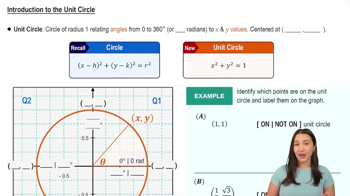
The unit circle is a circle with a radius of one centered at the origin of a coordinate plane. It is fundamental in trigonometry as it provides a geometric representation of the sine and cosine functions. The angles measured in radians correspond to points on the circle, where the x-coordinate represents cosine and the y-coordinate represents sine.
Recommended video:
Introduction to the Unit Circle
Sine Function
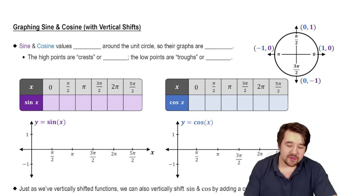
The sine function, denoted as sin(θ), is a fundamental trigonometric function that relates the angle θ to the ratio of the length of the opposite side to the hypotenuse in a right triangle. In the context of the unit circle, it gives the y-coordinate of a point on the circle corresponding to the angle θ. Understanding the values of sine for specific angles is crucial for solving trigonometric equations.
Recommended video:
Graph of Sine and Cosine Function
Quadrants of the Unit Circle
The unit circle is divided into four quadrants, each corresponding to different signs of the sine and cosine values. In the first quadrant, both sine and cosine are positive; in the second, sine is positive and cosine is negative; in the third, both are negative; and in the fourth, sine is negative and cosine is positive. For the equation sin(s) = -√3/2, we need to identify the angles in the third and fourth quadrants where sine takes on this negative value.
Recommended video:
Introduction to the Unit Circle
Related Practice
Textbook Question
783
views
Textbook Question
Fill in the blank(s) to correctly complete each sentence.
An equilateral triangle has _________________ equal sides.
509
views

Textbook Question
Find the angle of least positive measure that is coterminal with each angle. 792°
615
views
Textbook Question
CONCEPT PREVIEW Fill in the blank(s) to correctly complete each sentence. Given tan θ = 1/cot θ , two equivalent forms of this identity are cot θ = 1/______ and tan θ . ______ = 1 .
817
views
Textbook Question
Solve each problem. Rotating Propeller The propeller of a speedboat rotates 650 times per min. Through how many degrees does a point on the edge of the propeller rotate in 2.4 sec?
601
views
Textbook Question
Fill in the blank(s) to correctly complete each sentence.
An isosceles right triangle has one ________________ angle and ______________ equal sides.
532
views