Ch. 4 - Graphs of the Circular Functions
Lial - Trigonometry 12th Edition
Lial12th EditionTrigonometryISBN: 9780136552161Not the one you use?Change textbook
Chapter 5, Problem 53

Graph each function over a two-period interval. See Example 4.
y = -1 - 2 cos 5x

Verified step by step guidance
1
Identify the given function: \(y = -1 - 2 \cos 5x\). Notice that it is a cosine function with amplitude, vertical shift, and frequency modifications.
Determine the period of the function. The general period formula for \(\cos(bx)\) is \(\frac{2\pi}{b}\). Here, \(b = 5\), so the period is \(\frac{2\pi}{5}\).
Since the problem asks to graph over a two-period interval, calculate the interval length as \(2 \times \frac{2\pi}{5} = \frac{4\pi}{5}\). So, the graph should be drawn from \(x = 0\) to \(x = \frac{4\pi}{5}\) (or any interval of length \(\frac{4\pi}{5}\)).
Identify key features of the graph: amplitude is \(2\) (from the coefficient of cosine), vertical shift is \(-1\) (the constant term), and the cosine function is reflected and shifted downward because of the negative signs.
Plot key points within one period by evaluating \(y\) at important \(x\) values such as \(0\), \(\frac{\pi}{10}\), \(\frac{\pi}{5}\), \(\frac{3\pi}{10}\), and \(\frac{2\pi}{5}\), then extend the pattern to cover two periods. Connect these points smoothly to complete the graph.

Verified video answer for a similar problem:

This video solution was recommended by our tutors as helpful for the problem above.
Was this helpful?

Key Concepts

Here are the essential concepts you must grasp in order to answer the question correctly.

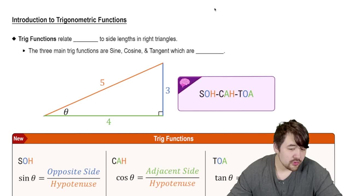
Graphing Trigonometric Functions

Graphing trigonometric functions involves plotting their values over a specified interval, showing periodic behavior. Understanding how amplitude, period, phase shift, and vertical shift affect the graph is essential to accurately sketch the function.
Recommended video:
6:04
Introduction to Trigonometric Functions

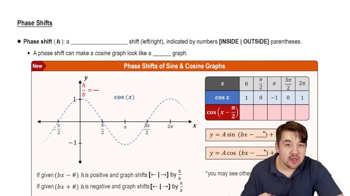
Amplitude and Vertical Shift

Amplitude is the height from the midline to the peak of the wave, determined by the coefficient of the cosine function. The vertical shift moves the entire graph up or down, controlled by the constant added or subtracted outside the cosine term.
Recommended video:
6:31
Phase Shifts

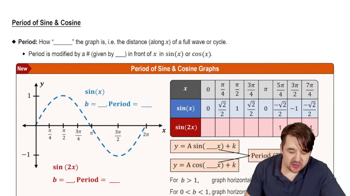
Period of a Cosine Function

The period is the length of one complete cycle of the cosine wave, calculated as 2π divided by the coefficient of x inside the cosine. For y = -1 - 2 cos 5x, the period is 2π/5, which determines the interval over which the function repeats.
Recommended video:
5:33
Period of Sine and Cosine Functions