
Ch. 3 - Radian Measure and The Unit Circle
Lial - Trigonometry 12th Edition
Lial12th EditionTrigonometryISBN: 9780136552161Not the one you use?Change textbook
Chapter 4, Problem 43

Without using a calculator, determine which of the two values is greater.
cos 2 or sin 2

Verified step by step guidance
1
Recall the fundamental trigonometric identity: \(\sin^2 x + \cos^2 x = 1\). This relationship connects sine and cosine values for the same angle.
Express \(\sin 2\) in terms of \(\cos 2\) using the identity. Since \(\sin^2 2 + \cos^2 2 = 1\), we have \(\sin 2 = \pm \sqrt{1 - \cos^2 2}\).
Determine the sign of \(\sin 2\) by considering the angle 2 radians. Since 2 radians is between \(\pi/2\) and \(\pi\) (approximately 1.57 to 3.14), \(\sin 2\) is positive in this interval.
Estimate the approximate values of \(\cos 2\) and \(\sin 2\) without a calculator by recalling the unit circle or known values: \(\cos 2\) is negative (since 2 radians is in the second quadrant), and \(\sin 2\) is positive.
Compare the two values based on their signs and approximate magnitudes: since \(\cos 2\) is negative and \(\sin 2\) is positive, conclude which is greater without calculating exact values.

Verified video answer for a similar problem:

This video solution was recommended by our tutors as helpful for the problem above.
Video duration:
2m
Was this helpful?

Key Concepts

Here are the essential concepts you must grasp in order to answer the question correctly.

Understanding the Range and Behavior of Sine and Cosine Functions

Sine and cosine functions oscillate between -1 and 1. Knowing their values at specific angles, especially in radians, helps compare their magnitudes. Since 2 radians is between π/2 and π, sine and cosine have predictable signs and approximate values in this interval.
Recommended video:
5:53
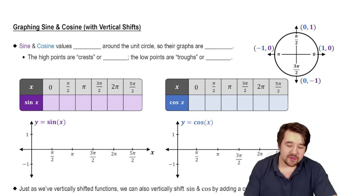
Graph of Sine and Cosine Function

Evaluating Trigonometric Functions at Specific Angles Without a Calculator

Estimating sine and cosine values at non-standard angles involves understanding the unit circle and reference angles. For 2 radians, which is about 114.6°, sine is positive and cosine is negative, allowing qualitative comparison without exact calculation.
Recommended video:
3:48
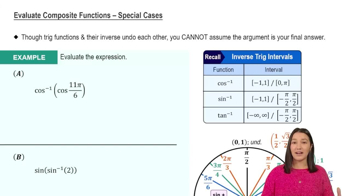
Evaluate Composite Functions - Special Cases

Comparing Numerical Values of Trigonometric Functions

To determine which value is greater, compare the approximate magnitudes and signs of sine and cosine at the given angle. Since cosine 2 is negative and sine 2 is positive, sine 2 is greater, illustrating the importance of sign and magnitude in comparisons.
Recommended video:
6:04
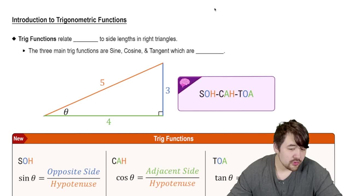
Introduction to Trigonometric Functions