Determine whether each statement is true or false. If false, tell why. csc 22° ≤ csc 68°
Table of contents
- 0. Review of College Algebra4h 45m
- 1. Measuring Angles40m
- 2. Trigonometric Functions on Right Triangles2h 5m
- 3. Unit Circle1h 19m
- 4. Graphing Trigonometric Functions1h 19m
- 5. Inverse Trigonometric Functions and Basic Trigonometric Equations1h 41m
- 6. Trigonometric Identities and More Equations2h 34m
- 7. Non-Right Triangles1h 38m
- 8. Vectors2h 25m
- 9. Polar Equations2h 5m
- 10. Parametric Equations1h 6m
- 11. Graphing Complex Numbers1h 7m
3. Unit Circle
Defining the Unit Circle
Problem 48
Textbook Question
Determine whether each statement is true or false. See Example 4. csc 20° < csc 30°
Verified step by step guidance1
Recall the definition of the cosecant function: \(\csc \theta = \frac{1}{\sin \theta}\). This means that to compare \(\csc 20^\circ\) and \(\csc 30^\circ\), we need to compare \(\frac{1}{\sin 20^\circ}\) and \(\frac{1}{\sin 30^\circ}\).
Since \(\csc \theta\) is the reciprocal of \(\sin \theta\), the inequality \(\csc 20^\circ < \csc 30^\circ\) is equivalent to \(\frac{1}{\sin 20^\circ} < \frac{1}{\sin 30^\circ}\).
To compare these, consider the values of \(\sin 20^\circ\) and \(\sin 30^\circ\). Remember that \(\sin 30^\circ = \frac{1}{2}\), which is a known exact value.
Since \(\sin 20^\circ\) is less than \(\sin 30^\circ\), and both sines are positive in the first quadrant, the reciprocal relationship means \(\csc 20^\circ\) will be greater than \(\csc 30^\circ\).
Therefore, the statement \(\csc 20^\circ < \csc 30^\circ\) is false because \(\csc 20^\circ\) is actually greater than \(\csc 30^\circ\).
Verified video answer for a similar problem:This video solution was recommended by our tutors as helpful for the problem above
Video duration:
1mPlay a video:
0 Comments
Key Concepts
Here are the essential concepts you must grasp in order to answer the question correctly.
Definition of the Cosecant Function
The cosecant function, csc(θ), is the reciprocal of the sine function, defined as csc(θ) = 1/sin(θ). It is important to understand this relationship to compare values of csc at different angles.
Recommended video:
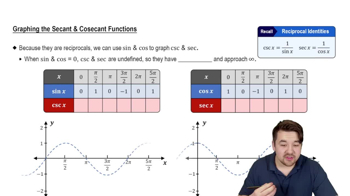
Graphs of Secant and Cosecant Functions
Behavior of the Sine Function in the First Quadrant
In the first quadrant (0° to 90°), the sine function increases as the angle increases. Since sine values increase, their reciprocals (cosecants) decrease, which affects the comparison between csc 20° and csc 30°.
Recommended video:
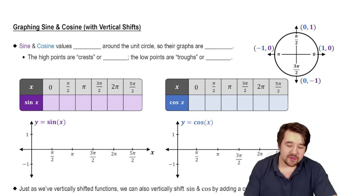
Graph of Sine and Cosine Function
Comparing Trigonometric Values
To determine inequalities involving trigonometric functions, it is essential to evaluate or estimate their values accurately. For example, knowing sin 20° ≈ 0.342 and sin 30° = 0.5 helps conclude that csc 20° > csc 30°.
Recommended video:
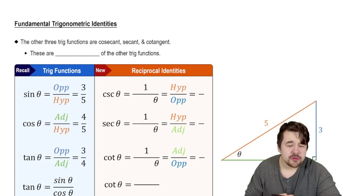
Fundamental Trigonometric Identities
Related Videos
Related Practice
Textbook Question
559
views