Ch. R - Algebra Review
Lial - Trigonometry 12th Edition
Lial12th EditionTrigonometryISBN: 9780136552161Not the one you use?Change textbook
Chapter 1, Problem 69

Use the graph of y = ƒ(x) to find each function value: (a) ƒ(-2) (b) ƒ(0) (c) ƒ(1) and (d) ƒ(4). See Example 7(d).

Verified step by step guidance
1
Identify the function ƒ(x) from the given graph. This means understanding how the graph represents the relationship between x and y, where y = ƒ(x).
For each value of x given (i.e., -2, 0, 1, and 4), locate the corresponding point on the x-axis of the graph.
From each x-value, move vertically to the point on the graph that corresponds to that x. The y-coordinate of this point is the value of ƒ(x) at that x.
Write down the y-coordinate for each x-value: ƒ(-2), ƒ(0), ƒ(1), and ƒ(4). These are the function values you are asked to find.
Double-check each point on the graph to ensure accuracy, especially if the graph has curves or sharp turns, to correctly read the y-values.

Verified video answer for a similar problem:

This video solution was recommended by our tutors as helpful for the problem above.
Video duration:
2m
Was this helpful?

Key Concepts

Here are the essential concepts you must grasp in order to answer the question correctly.

Understanding Function Notation

Function notation, written as ƒ(x), represents the output value of a function ƒ for a given input x. Evaluating ƒ(a) means finding the y-value on the graph corresponding to the x-value a. This concept is essential for interpreting and extracting values from the graph.
Recommended video:
06:01
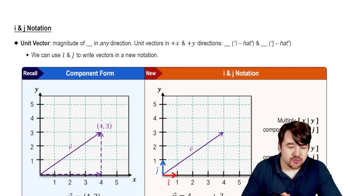
i & j Notation

Reading Graphs of Functions

Reading a graph involves locating specific x-values on the horizontal axis and identifying the corresponding y-values on the vertical axis. This skill allows you to determine function values visually without algebraic expressions, which is crucial for answering questions based on graphs.
Recommended video:
5:53
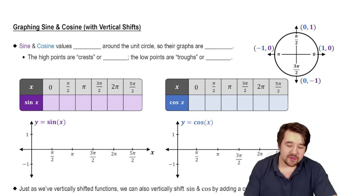
Graph of Sine and Cosine Function

Domain and Range of a Function

The domain is the set of all possible input values (x-values) for which the function is defined, while the range is the set of all possible output values (y-values). Understanding domain ensures you only evaluate ƒ(x) at valid points on the graph.
Recommended video:
4:22
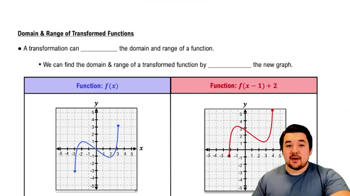
Domain and Range of Function Transformations