Table of contents
- 0. Review of College Algebra4h 45m
- 1. Measuring Angles40m
- 2. Trigonometric Functions on Right Triangles2h 5m
- 3. Unit Circle1h 19m
- 4. Graphing Trigonometric Functions1h 19m
- 5. Inverse Trigonometric Functions and Basic Trigonometric Equations1h 41m
- 6. Trigonometric Identities and More Equations2h 34m
- 7. Non-Right Triangles1h 38m
- 8. Vectors2h 25m
- 9. Polar Equations2h 5m
- 10. Parametric Equations1h 6m
- 11. Graphing Complex Numbers1h 7m
10. Parametric Equations
Graphing Parametric Equations
Problem 33
Textbook Question
Graph each plane curve defined by the parametric equations for t in [0, 2π] Then find a rectangular equation for the plane curve. See Example 3.
x = 2 + sin t , y = 1 + cos t
Verified step by step guidance1
Identify the given parametric equations: \(x = 2 + \sin t\) and \(y = 1 + \cos t\), where \(t\) ranges from \$0$ to \(2\pi\).
Recall the Pythagorean identity: \(\sin^2 t + \cos^2 t = 1\). This identity will help us eliminate the parameter \(t\) to find a rectangular equation.
Express \(\sin t\) and \(\cos t\) in terms of \(x\) and \(y\): from \(x = 2 + \sin t\), we get \(\sin t = x - 2\); from \(y = 1 + \cos t\), we get \(\cos t = y - 1\).
Substitute these expressions into the Pythagorean identity: \((x - 2)^2 + (y - 1)^2 = 1\).
Interpret this rectangular equation as a circle centered at \((2, 1)\) with radius \$1\(, which corresponds to the curve traced by the parametric equations for \)t$ in \([0, 2\pi]\).
Verified video answer for a similar problem:This video solution was recommended by our tutors as helpful for the problem above
Video duration:
5mPlay a video:
0 Comments
Key Concepts
Here are the essential concepts you must grasp in order to answer the question correctly.
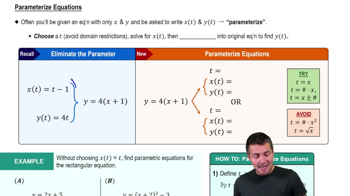
Parametric Equations
Parametric equations express the coordinates of points on a curve as functions of a parameter, often denoted as t. Instead of y as a function of x, both x and y depend on t, allowing the description of more complex curves and motions.
Recommended video:
Parameterizing Equations
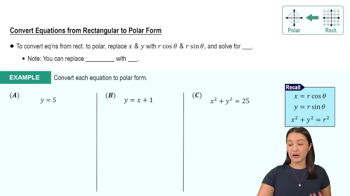
Rectangular Equation Conversion
Converting parametric equations to a rectangular equation involves eliminating the parameter t to find a direct relationship between x and y. This often uses trigonometric identities or algebraic manipulation to rewrite the curve in the standard Cartesian form.
Recommended video:
Convert Equations from Rectangular to Polar
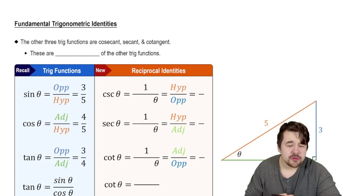
Trigonometric Identities
Trigonometric identities, such as sin²t + cos²t = 1, are essential tools for eliminating parameters in parametric equations. They help relate sine and cosine terms to each other, enabling the derivation of a rectangular equation from parametric forms.
Recommended video:
Fundamental Trigonometric Identities
Related Videos
Related Practice
Textbook Question
Find two different sets of parametric equations for y = x² + 6.
597
views