Ch. 2 - Acute Angles and Right Triangles
Lial - Trigonometry 12th Edition
Lial12th EditionTrigonometryISBN: 9780136552161Not the one you use?Change textbook
Chapter 3, Problem 30

Find exact values of the six trigonometric functions of each angle. Rationalize denominators when applicable. See Examples 2, 3, and 5. -390°

Verified step by step guidance
1
Step 1: Understand that the angle given is -390°, which is a negative angle. To find the trigonometric functions, first convert this angle to a positive coterminal angle by adding 360° repeatedly until the angle is between 0° and 360°. So, calculate \(-390° + 360° = -30°\). Since -30° is still negative, add 360° again: \(-30° + 360° = 330°\). Thus, the coterminal positive angle is 330°.
Step 2: Identify the reference angle for 330°. The reference angle is the acute angle formed with the x-axis. Since 330° is in the fourth quadrant, the reference angle is \(360° - 330° = 30°\).
Step 3: Recall the exact trigonometric values for 30°: \(\sin 30° = \frac{1}{2}\), \(\cos 30° = \frac{\sqrt{3}}{2}\), and \(\tan 30° = \frac{1}{\sqrt{3}}\). Use these as the basis for the values at 330°, adjusting signs according to the quadrant.
Step 4: Determine the signs of the trigonometric functions in the fourth quadrant (where 330° lies). In the fourth quadrant, cosine is positive, sine is negative, and tangent is negative. Apply these signs to the reference angle values to find \(\sin 330°\), \(\cos 330°\), and \(\tan 330°\).
Step 5: Use the primary sine, cosine, and tangent values to find the remaining three trigonometric functions: cosecant (\(\csc \theta = \frac{1}{\sin \theta}\)), secant (\(\sec \theta = \frac{1}{\cos \theta}\)), and cotangent (\(\cot \theta = \frac{1}{\tan \theta}\)). Remember to rationalize denominators where necessary.

Verified video answer for a similar problem:

This video solution was recommended by our tutors as helpful for the problem above.
Video duration:
8m
Was this helpful?

Key Concepts

Here are the essential concepts you must grasp in order to answer the question correctly.

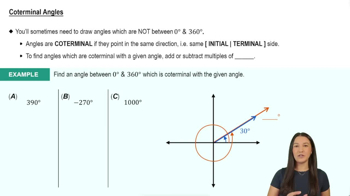
Reference Angles and Coterminal Angles

To find trigonometric values for angles like -390°, first determine a coterminal angle between 0° and 360° by adding or subtracting 360°. The reference angle is the acute angle formed with the x-axis, which helps in evaluating trigonometric functions using known values.
Recommended video:
04:46
Coterminal Angles

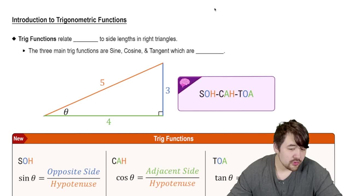
Signs of Trigonometric Functions in Different Quadrants

The sign of sine, cosine, and tangent depends on the quadrant where the angle lies. Knowing the quadrant of the coterminal angle helps assign the correct positive or negative sign to each trigonometric function based on the ASTC (All Students Take Calculus) rule.
Recommended video:
6:04
Introduction to Trigonometric Functions

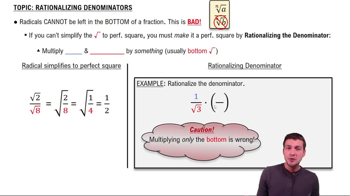
Exact Values and Rationalizing Denominators

Exact trigonometric values often involve square roots and fractions. Rationalizing denominators means rewriting expressions to eliminate radicals from the denominator, ensuring the answer is in a simplified, standard form preferred in trigonometry.
Recommended video:
2:58
Rationalizing Denominators