Ch. 2 - Graphs of the Trigonometric Functions; Inverse Trigonometric Functions
Blitzer - Trigonometry 3rd Edition
Blitzer3rd EditionTrigonometryISBN: 9780137316601Not the one you use?Change textbook
Chapter 2, Problem 5

Find the exact value of each expression. sin⁻¹ (- 1/2)

Verified step by step guidance
1
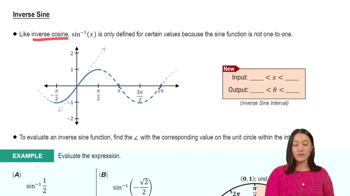
Recall that \(\sin^{-1}(x)\), or arcsin, is the inverse sine function which gives the angle whose sine is \(x\), with the range of \(\sin^{-1}(x)\) being \([-\frac{\pi}{2}, \frac{\pi}{2}]\) (or \([-90^\circ, 90^\circ]\)).
Identify the value inside the inverse sine function: here it is \(-\frac{1}{2}\). We need to find an angle \(\theta\) such that \(\sin(\theta) = -\frac{1}{2}\) and \(\theta\) lies within \([-\frac{\pi}{2}, \frac{\pi}{2}]\).
Recall the sine values of common angles: \(\sin(\frac{\pi}{6}) = \frac{1}{2}\). Since we want \(-\frac{1}{2}\), the angle must be the negative of \(\frac{\pi}{6}\) because sine is an odd function, meaning \(\sin(-\theta) = -\sin(\theta)\).
Therefore, the angle \(\theta\) that satisfies \(\sin(\theta) = -\frac{1}{2}\) in the range \([-\frac{\pi}{2}, \frac{\pi}{2}]\) is \(-\frac{\pi}{6}\).
Express the final answer as \(\sin^{-1}(-\frac{1}{2}) = -\frac{\pi}{6}\), which is the exact value.

Verified video answer for a similar problem:

This video solution was recommended by our tutors as helpful for the problem above.
Video duration:
5m
Was this helpful?

Key Concepts

Here are the essential concepts you must grasp in order to answer the question correctly.

Inverse Sine Function (sin⁻¹ or arcsin)

The inverse sine function, denoted as sin⁻¹ or arcsin, returns the angle whose sine value is a given number. It is defined for inputs between -1 and 1 and outputs angles in the range [-π/2, π/2] or [-90°, 90°]. Understanding this range is crucial for finding the correct angle.
Recommended video:
4:03
Inverse Sine

Exact Values of Sine for Special Angles

Certain angles have well-known sine values, such as sin(30°) = 1/2 and sin(-30°) = -1/2. Recognizing these exact values helps in quickly determining the angle corresponding to a given sine value without a calculator.
Recommended video:
3:28
Common Trig Functions For 45-45-90 Triangles

Domain and Range Restrictions of Inverse Trigonometric Functions

Inverse trigonometric functions have restricted domains and ranges to ensure they are functions. For sin⁻¹, the input must be between -1 and 1, and the output angle lies between -90° and 90°. This restriction ensures a unique solution for the inverse sine.
Recommended video:
4:22
Domain and Range of Function Transformations