
Textbook Question
Solve each quadratic equation using the quadratic formula. See Example 7. -2x² + 4x + 3 = 0
72
views

 Verified step by step guidance
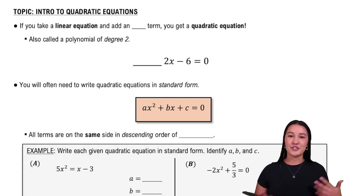
 5:35
5:35
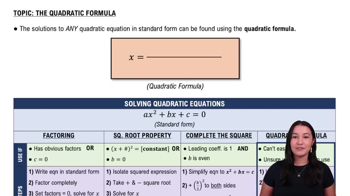 6:36
6:36Solve each quadratic equation using the quadratic formula. See Example 7. -2x² + 4x + 3 = 0
Solve each inequality. Give the solution set using interval notation. See Examples 8 and 9. -3(x - 6) > 2x - 2
Solve each inequality. Give the solution set using interval notation. See Example 10. -9 ≤ x + 5 ≤ 15
Determine whether each equation is an identity, a conditional equation, or a contradiction. Give the solution set. See Example 4. 4(2x + 7) = 2x + 22 + 3(2x + 2)
Solve each quadratic equation using the zero-factor property. See Example 5. 4x² - 4x + 1 = 0
Solve each inequality. Give the solution set using interval notation. See Examples 8 and 9. 4x + 7 ———— ≤ 2x + 5 -3