Ch. R - Algebra Review
Lial - Trigonometry 12th Edition
Lial12th EditionTrigonometryISBN: 9780136552161Not the one you use?Change textbook
Chapter 1, Problem R.6.91

Solve each inequality. Give the solution set using interval notation. See Example 10. -9 ≤ x + 5 ≤ 15

Verified step by step guidance
1
Start with the compound inequality: \(-9 \leq x + 5 \leq 15\).
To isolate \(x\), subtract 5 from all three parts of the inequality: \(-9 - 5 \leq x + 5 - 5 \leq 15 - 5\).
Simplify each part: \(-14 \leq x \leq 10\).
Interpret the solution: \(x\) is greater than or equal to \(-14\) and less than or equal to \(10\).
Express the solution set in interval notation as \([-14, 10]\).

Verified video answer for a similar problem:

This video solution was recommended by our tutors as helpful for the problem above.
Video duration:
3m

Key Concepts

Here are the essential concepts you must grasp in order to answer the question correctly.

Compound Inequalities

Compound inequalities involve two inequalities combined into one statement, such as -9 ≤ x + 5 ≤ 15. Solving them requires isolating the variable by performing operations on all parts of the inequality simultaneously to maintain the inequality's truth.
Recommended video:
5:10
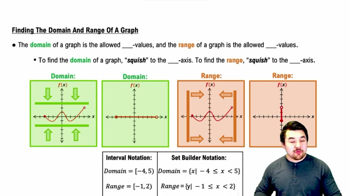
Finding the Domain and Range of a Graph

Properties of Inequalities

When solving inequalities, adding, subtracting, multiplying, or dividing all parts by the same positive number preserves the inequality direction. Multiplying or dividing by a negative number reverses the inequality signs. Understanding these properties ensures correct manipulation of inequalities.
Recommended video:
2:20
Imaginary Roots with the Square Root Property

Interval Notation

Interval notation expresses solution sets of inequalities concisely using brackets and parentheses. Brackets [ ] indicate inclusion of endpoints, while parentheses ( ) indicate exclusion. For example, [a, b] means all values from a to b, including a and b.
Recommended video:
06:01
i & j Notation