Ch. 3 - Trigonometric Identities and Equations
Blitzer - Trigonometry 3rd Edition
Blitzer3rd EditionTrigonometryISBN: 9780137316601Not the one you use?Change textbook
Chapter 3, Problem 79

In Exercises 63–84, use an identity to solve each equation on the interval [0, 2𝝅). sin ( x + 𝝅/4) + sin ( x - 𝝅/4 ) = 1

Verified step by step guidance
1
Recognize that the equation involves the sum of two sine functions with arguments that differ by a constant. Recall the sine sum-to-product identity: \(\sin A + \sin B = 2 \sin \left( \frac{A+B}{2} \right) \cos \left( \frac{A-B}{2} \right)\).
Identify \(A = x + \frac{\pi}{4}\) and \(B = x - \frac{\pi}{4}\). Substitute these into the identity to rewrite the left side of the equation as \(2 \sin \left( \frac{(x + \frac{\pi}{4}) + (x - \frac{\pi}{4})}{2} \right) \cos \left( \frac{(x + \frac{\pi}{4}) - (x - \frac{\pi}{4})}{2} \right)\).
Simplify the arguments inside the sine and cosine functions: the sine argument becomes \(\frac{2x}{2} = x\), and the cosine argument becomes \(\frac{\frac{\pi}{4} + \frac{\pi}{4}}{2} = \frac{\pi}{4}\).
Rewrite the equation as \(2 \sin x \cos \frac{\pi}{4} = 1\). Since \(\cos \frac{\pi}{4}\) is a known value, express it explicitly to simplify the equation further.
Solve for \(\sin x\) by dividing both sides by \(2 \cos \frac{\pi}{4}\), then find all solutions for \(x\) in the interval \([0, 2\pi)\) where \(\sin x\) equals that value.

Verified video answer for a similar problem:

This video solution was recommended by our tutors as helpful for the problem above.
Video duration:
3m
Was this helpful?

Key Concepts

Here are the essential concepts you must grasp in order to answer the question correctly.

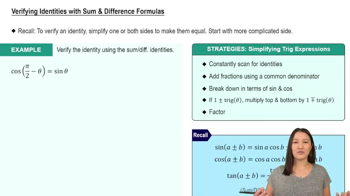
Sum-to-Product Identities

Sum-to-product identities transform sums of sine or cosine functions into products, simplifying the solving process. For example, sin(A) + sin(B) = 2 sin((A+B)/2) cos((Aβˆ’B)/2). Applying this helps rewrite the given equation into a more manageable form.
Recommended video:
2:25
Verifying Identities with Sum and Difference Formulas

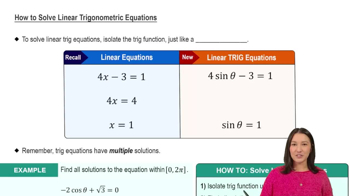
Solving Trigonometric Equations on a Given Interval

Solving trigonometric equations involves finding all angle solutions within a specified interval, here [0, 2Ο€). This requires considering the periodicity of sine and cosine functions and checking all possible solutions that satisfy the equation within the interval.
Recommended video:
4:34
How to Solve Linear Trigonometric Equations

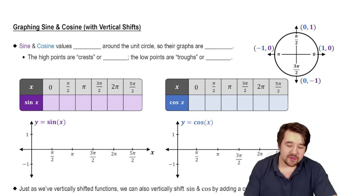
Basic Properties of the Sine Function

Understanding the sine function’s range (βˆ’1 to 1), periodicity (2Ο€), and symmetry is essential. These properties help determine valid solutions and simplify expressions, especially when combined with angle addition or subtraction inside the sine function.
Recommended video:
5:53
Graph of Sine and Cosine Function