Ch. 5 - Trigonometric Identities
Lial - Trigonometry 12th Edition
Lial12th EditionTrigonometryISBN: 9780136552161Not the one you use?Change textbook
Chapter 6, Problem 44

Simplify each expression. See Example 4.
tan 34°/2(1 - tan² 34°)

Verified step by step guidance
1
Recognize that the expression resembles the double-angle formula for tangent. Recall the formula: \(\tan(2\theta) = \frac{2 \tan \theta}{1 - \tan^2 \theta}\).
Compare the given expression \(\frac{\tan 34^\circ}{2(1 - \tan^2 34^\circ)}\) with the double-angle formula. Notice that the numerator and denominator are arranged differently.
Rewrite the given expression to see if it can be manipulated into the form of the double-angle formula. For example, consider multiplying numerator and denominator appropriately or factoring to match the formula's structure.
Use the double-angle identity to express \(\tan 68^\circ\) in terms of \(\tan 34^\circ\) and relate it back to the given expression.
Conclude the simplification by substituting the equivalent double-angle expression, which will simplify the original expression into a single tangent function or a simpler trigonometric expression.

Verified video answer for a similar problem:

This video solution was recommended by our tutors as helpful for the problem above.
Was this helpful?

Key Concepts

Here are the essential concepts you must grasp in order to answer the question correctly.

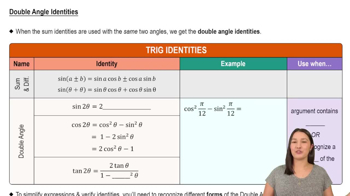
Tangent Double-Angle Identity

The tangent double-angle identity expresses tan(2θ) in terms of tan(θ): tan(2θ) = 2 tan(θ) / (1 - tan²(θ)). This identity helps simplify expressions involving tangent of multiple angles by rewriting them in terms of a single angle.
Recommended video:
05:06
Double Angle Identities

Algebraic Simplification of Trigonometric Expressions

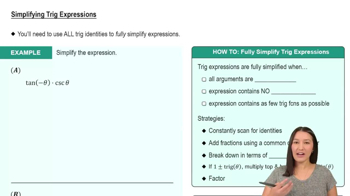
Simplifying trigonometric expressions often involves factoring, combining like terms, and applying identities. Recognizing patterns such as the double-angle formula allows rewriting complex fractions into simpler forms.
Recommended video:
6:36
Simplifying Trig Expressions

Evaluating Trigonometric Functions at Specific Angles

Understanding how to evaluate or manipulate trigonometric functions at given angles, like 34°, is essential. This includes knowing approximate values or using identities to rewrite expressions for easier calculation or simplification.
Recommended video:
3:48
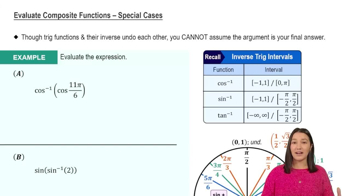
Evaluate Composite Functions - Special Cases