
Ch. 2 - Acute Angles and Right Triangles
Lial - Trigonometry 12th Edition
Lial12th EditionTrigonometryISBN: 9780136552161Not the one you use?Change textbook
Chapter 3, Problem 56

Determine whether each statement is true or false. If false, tell why. See Example 4. cos 60° = 2 cos² 30° - 1

Verified step by step guidance
1
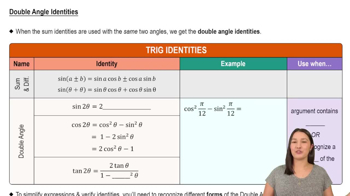
Recall the double-angle identity for cosine: \(\cos(2\theta) = 2\cos^{2}(\theta) - 1\).
Identify the angle in the problem: here, \(60^\circ\) is given, and the right side uses \(\cos^{2}(30^\circ)\).
Check if \(60^\circ\) can be expressed as \(2 \times 30^\circ\), which it can, so the identity applies with \(\theta = 30^\circ\).
Substitute \(\theta = 30^\circ\) into the identity: \(\cos(60^\circ) = 2\cos^{2}(30^\circ) - 1\).
Since this matches the given statement exactly, conclude that the statement is true based on the double-angle formula.

Verified video answer for a similar problem:

This video solution was recommended by our tutors as helpful for the problem above.
Video duration:
2m
Was this helpful?

Key Concepts

Here are the essential concepts you must grasp in order to answer the question correctly.

Cosine Double-Angle Identity

The cosine double-angle identity states that cos(2θ) = 2cos²(θ) - 1. This formula allows expressing the cosine of twice an angle in terms of the cosine of the original angle, which is essential for verifying or simplifying trigonometric expressions involving double angles.
Recommended video:
05:06
Double Angle Identities

Evaluating Trigonometric Functions at Specific Angles

Knowing exact values of trigonometric functions at common angles like 30°, 60°, and 90° is crucial. For example, cos 60° = 1/2 and cos 30° = √3/2. These values help in directly substituting and verifying the truth of trigonometric statements.
Recommended video:
3:48
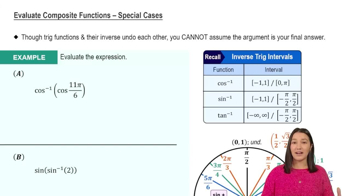
Evaluate Composite Functions - Special Cases

Verification of Trigonometric Equations

To determine if a trigonometric statement is true or false, substitute known values or use identities to simplify both sides. Comparing the results confirms the statement's validity or reveals why it is false, which is key in problem-solving.
Recommended video:
4:34
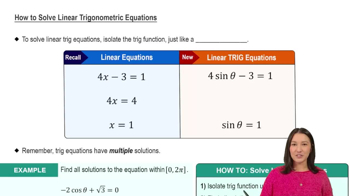
How to Solve Linear Trigonometric Equations