Ch. R - Algebra Review
Lial - Trigonometry 12th Edition
Lial12th EditionTrigonometryISBN: 9780136552161Not the one you use?Change textbook
Chapter 1, Problem R.2.143

Simplify each expression. See Example 8. 10x (3)(y)

Verified step by step guidance
1
Identify the expression given: \$10x (3)(y)$. This involves multiplication of constants and variables.
Rewrite the expression by grouping the constants and variables separately: \((10 \times 3) \times (x \times y)\).
Multiply the constants together: \(10 \times 3 = 30\).
Combine the variables by multiplication: \(x \times y = xy\).
Write the simplified expression by combining the results: \$30xy$.

Verified video answer for a similar problem:

This video solution was recommended by our tutors as helpful for the problem above.
Video duration:
1m
Was this helpful?

Key Concepts

Here are the essential concepts you must grasp in order to answer the question correctly.

Algebraic Simplification

Algebraic simplification involves combining like terms and applying arithmetic operations to rewrite expressions in a simpler form. In this context, it means multiplying constants and variables correctly to reduce the expression to its simplest equivalent.
Recommended video:
04:12
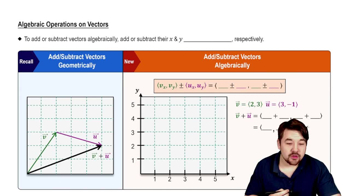
Algebraic Operations on Vectors

Multiplication of Variables and Constants

When multiplying variables and constants, multiply the numerical coefficients and then write the variables together. For example, multiplying 10x by 3y involves multiplying 10 and 3 to get 30, and then combining the variables x and y as xy.
Recommended video:
5:28
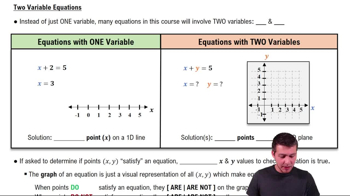
Equations with Two Variables

Understanding Notation and Expression Structure

Recognizing how expressions are written, such as 10x(3)(y), helps in correctly applying operations. Parentheses indicate multiplication, so the expression means 10 times x times 3 times y, which guides the order and method of simplification.
Recommended video:
06:01
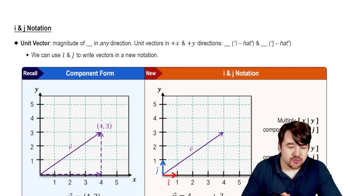
i & j Notation