In Exercises 1–26, find the exact value of each expression._cot⁻¹ (−√3)
Verified step by step guidance
1
Recognize that \( \cot^{-1}(x) \) is the inverse cotangent function, which gives the angle whose cotangent is \( x \).
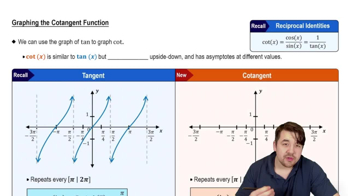
Recall that \( \cot(\theta) = \frac{1}{\tan(\theta)} \), so \( \cot(\theta) = -\sqrt{3} \) implies \( \tan(\theta) = -\frac{1}{\sqrt{3}} \).
Identify the reference angle where \( \tan(\theta) = \frac{1}{\sqrt{3}} \), which is \( \frac{\pi}{6} \) or \( 30^\circ \).
Since the tangent is negative, determine the quadrants where tangent is negative: Quadrants II and IV.
Find the angle in the appropriate quadrant that corresponds to \( \tan(\theta) = -\frac{1}{\sqrt{3}} \), which will be \( \theta = \frac{5\pi}{6} \) or \( 150^\circ \) in Quadrant II.
Verified video answer for a similar problem:
This video solution was recommended by our tutors as helpful for the problem above
Video duration:
7m
Play a video:
Was this helpful?
Key Concepts
Here are the essential concepts you must grasp in order to answer the question correctly.
Inverse Trigonometric Functions
Inverse trigonometric functions, such as cot⁻¹, are used to find angles when given a trigonometric ratio. For example, cot⁻¹(x) gives the angle whose cotangent is x. Understanding how these functions operate is crucial for solving problems involving angle determination from given ratios.
The cotangent function is defined as the ratio of the adjacent side to the opposite side in a right triangle, or as the reciprocal of the tangent function. Specifically, cot(θ) = 1/tan(θ). Knowing the properties of the cotangent function helps in determining the angle corresponding to a specific cotangent value.
Trigonometric functions have different signs in different quadrants of the unit circle. For cot⁻¹(−√3), it is essential to recognize that the negative value indicates the angle lies in either the second or fourth quadrant. Understanding the unit circle and the behavior of trigonometric functions in various quadrants is vital for accurately determining angle values.