Ch. 5 - Complex Numbers, Polar Coordinates and Parametric Equations
Blitzer - Trigonometry 3rd Edition
Blitzer3rd EditionTrigonometryISBN: 9780137316601Not the one you use?Change textbook
Chapter 5, Problem 5.3.54

In Exercises 49–58, convert each rectangular equation to a polar equation that expresses r in terms of θ.


x² + y² = 16

Verified step by step guidance
1
Recall the relationship between rectangular coordinates (x, y) and polar coordinates (r, \(\theta\)): \(x = r \cos\theta\) and \(y = r \sin\theta\).
Substitute \(x = r \cos\theta\) and \(y = r \sin\theta\) into the given equation \(x^{2} + y^{2} = 16\).
This substitution gives the equation \((r \cos\theta)^{2} + (r \sin\theta)^{2} = 16\).
Simplify the equation by factoring out \(r^{2}\): \(r^{2}(\cos^{2}\theta + \sin^{2}\theta) = 16\).
Use the Pythagorean identity \(\cos^{2}\theta + \sin^{2}\theta = 1\) to simplify to \(r^{2} = 16\), then solve for \(r\) to express it in terms of \(\theta\).

Verified video answer for a similar problem:

This video solution was recommended by our tutors as helpful for the problem above.
Video duration:
1m

Key Concepts

Here are the essential concepts you must grasp in order to answer the question correctly.

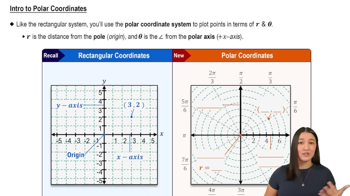
Rectangular and Polar Coordinate Systems

Rectangular coordinates represent points using (x, y) on a plane, while polar coordinates use (r, θ), where r is the distance from the origin and θ is the angle from the positive x-axis. Understanding how these systems relate is essential for converting equations between them.
Recommended video:
05:32
Intro to Polar Coordinates

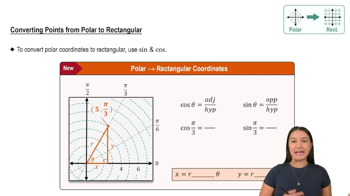
Relationship Between Rectangular and Polar Coordinates

The key formulas connecting the two systems are x = r cos θ and y = r sin θ. Additionally, r² = x² + y². These relationships allow substitution of x and y in terms of r and θ to rewrite rectangular equations in polar form.
Recommended video:
06:17
Convert Points from Polar to Rectangular

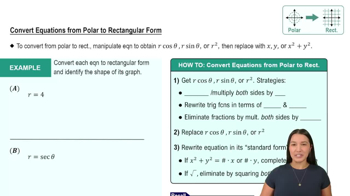
Converting Equations to Express r in Terms of θ

To convert a rectangular equation to polar form expressing r as a function of θ, substitute x and y with r cos θ and r sin θ, respectively, then solve algebraically for r. This process isolates r, showing how the radius varies with the angle θ.
Recommended video:
6:50
Convert Equations from Polar to Rectangular