Ch. 1 - Trigonometric Functions
Lial - Trigonometry 12th Edition
Lial12th EditionTrigonometryISBN: 9780136552161, 9780135440780, 9780136881117, 9780135440827, 9780135924891Not the one you use?Change textbook
Chapter 2, Problem 58

Convert each angle measure to decimal degrees. If applicable, round to the nearest thousandth of a degree. - 70° 48'

Verified step by step guidance
1
Identify the components of the angle: 70° (degrees) and 48' (minutes). Recall that 1 degree = 60 minutes.
Convert the minutes to decimal degrees by dividing the minutes by 60: calculate \(\frac{48}{60}\) degrees.
Add the decimal degrees obtained from the minutes to the whole degrees: \(70 + \frac{48}{60}\).
Perform the addition to express the angle entirely in decimal degrees.
If necessary, round the final decimal degree value to the nearest thousandth.

Verified video answer for a similar problem:

This video solution was recommended by our tutors as helpful for the problem above.
Video duration:
2m

Key Concepts

Here are the essential concepts you must grasp in order to answer the question correctly.

Degrees, Minutes, and Seconds (DMS) Notation

Angles can be expressed in degrees (°), minutes ('), and seconds ("), where 1 degree equals 60 minutes and 1 minute equals 60 seconds. This notation is commonly used in navigation and surveying to represent precise angle measures.
Recommended video:
Guided course
06:01
i & j Notation

Conversion from Minutes to Decimal Degrees

To convert an angle from DMS to decimal degrees, minutes are divided by 60 since there are 60 minutes in a degree. For example, 48 minutes is converted by calculating 48 ÷ 60 = 0.8 degrees, which is then added to the degrees part.
Recommended video:
Guided course
03:58
Converting Complex Numbers from Polar to Rectangular Form

Rounding Decimal Degrees

After converting the angle to decimal degrees, the result is often rounded to a specified precision, such as the nearest thousandth. This involves rounding the decimal portion to three decimal places to ensure clarity and consistency in measurements.
Recommended video:
Guided course
5:04
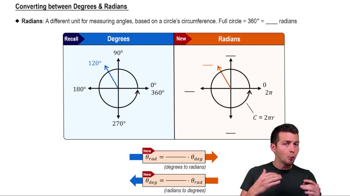
Converting between Degrees & Radians