Ch. 7 - Applications of Trigonometry and Vectors
Lial - Trigonometry 12th Edition
Lial12th EditionTrigonometryISBN: 9780136552161Not the one you use?Change textbook
Chapter 8, Problem 7.49

Solve each problem. See Examples 5 and 6.


Distance and Direction of a Motorboat A motorboat sets out in the direction N 80° 00′ E. The speed of the boat in still water is 20.0 mph. If the current is flowing directly south, and the actual direction of the motorboat is due east, find the speed of the current and the actual speed of the motorboat.


<IMAGE>

Verified step by step guidance
1
Step 1: Understand the problem setup. The motorboat is heading in the direction N 80° 00′ E, which means it is 80 degrees east of north. The current is flowing directly south, affecting the boat's path.
Step 2: Break down the velocity components. The boat's speed in still water is 20 mph. Decompose this velocity into northward and eastward components using trigonometry. The northward component is 20 * cos(80°) and the eastward component is 20 * sin(80°).
Step 3: Analyze the effect of the current. Since the current flows directly south, it only affects the northward component of the boat's velocity. Let the speed of the current be 'c'. The northward component of the boat's velocity becomes 20 * cos(80°) - c.
Step 4: Determine the actual direction. The problem states that the actual direction of the motorboat is due east, meaning the northward component of the velocity must be zero. Set the equation 20 * cos(80°) - c = 0 and solve for 'c' to find the speed of the current.
Step 5: Calculate the actual speed of the motorboat. The actual speed is the eastward component of the velocity, which remains unaffected by the current. Therefore, the actual speed is 20 * sin(80°).

Verified video answer for a similar problem:

This video solution was recommended by our tutors as helpful for the problem above.
Video duration:
5m
Was this helpful?

Key Concepts

Here are the essential concepts you must grasp in order to answer the question correctly.

Vector Addition

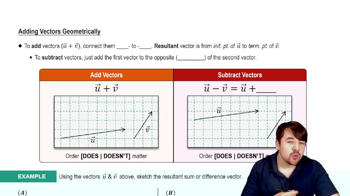
Vector addition is the process of combining two or more vectors to determine a resultant vector. In this problem, the motorboat's velocity and the current's velocity are represented as vectors. Understanding how to add these vectors graphically or mathematically is crucial for finding the actual speed and direction of the motorboat.
Recommended video:
05:29
Adding Vectors Geometrically

Trigonometric Functions

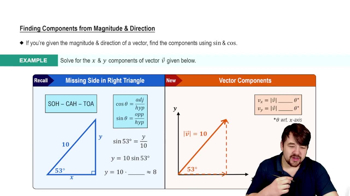
Trigonometric functions, such as sine, cosine, and tangent, relate the angles of a triangle to the lengths of its sides. In this scenario, these functions can be used to resolve the motorboat's velocity into its components, allowing for the calculation of the current's speed and the boat's actual speed when the direction changes due to the current.
Recommended video:
6:04
Introduction to Trigonometric Functions

Angle of Deviation

The angle of deviation refers to the angle between the intended direction of travel and the actual direction due to external influences, such as currents. In this case, the motorboat aims to travel N 80° E but ends up going due east, indicating a deviation caused by the southward current. Understanding this concept is essential for determining the current's effect on the boat's trajectory.
Recommended video:
04:46
Coterminal Angles