Ch. R - Algebra Review
Lial - Trigonometry 12th Edition
Lial12th EditionTrigonometryISBN: 9780136552161, 9780135440780, 9780136881117, 9780135440827, 9780135924891Not the one you use?Change textbook
Chapter 1, Problem 21

Concept Check Graph the points on a coordinate system and identify the quadrant or axis for each point. (3, 2)

Verified step by step guidance
1
Start by understanding the coordinate system: the horizontal axis is the x-axis and the vertical axis is the y-axis.
Locate the point (3, 2) by moving 3 units to the right along the x-axis because the x-coordinate is positive 3.
From that position, move 2 units up along the y-axis because the y-coordinate is positive 2.
Mark the point where these two movements intersect on the graph.
Identify the quadrant: since both x and y are positive, the point (3, 2) lies in Quadrant I.

Verified video answer for a similar problem:

This video solution was recommended by our tutors as helpful for the problem above.
Video duration:
1m

Key Concepts

Here are the essential concepts you must grasp in order to answer the question correctly.

Cartesian Coordinate System

The Cartesian coordinate system uses two perpendicular axes, the x-axis (horizontal) and y-axis (vertical), to locate points in a plane. Each point is represented by an ordered pair (x, y), where x indicates horizontal position and y indicates vertical position.
Recommended video:
Guided course
05:32
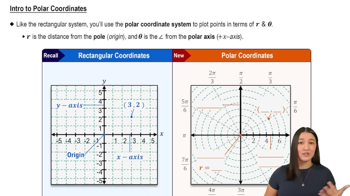
Intro to Polar Coordinates

Plotting Points

Plotting a point involves moving x units along the x-axis and y units along the y-axis from the origin (0,0). For example, the point (3, 2) is found by moving 3 units right and 2 units up from the origin.
Recommended video:
Guided course
4:29
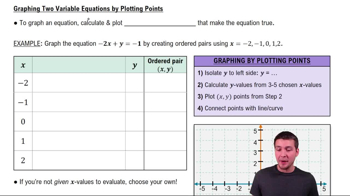
Graphing Two Variable Equations by Plotting Points

Quadrants and Axes Identification

The coordinate plane is divided into four quadrants based on the signs of x and y values: Quadrant I (+, +), Quadrant II (-, +), Quadrant III (-, -), and Quadrant IV (+, -). Points on the axes have either x=0 or y=0, indicating they lie on the x-axis or y-axis.
Recommended video:
Guided course
6:36
Quadratic Formula