Ch. R - Algebra Review
Lial - Trigonometry 12th Edition
Lial12th EditionTrigonometryISBN: 9780136552161Not the one you use?Change textbook
Chapter 1, Problem 75

Rewrite each statement with > so that it uses < instead. Rewrite each statement with < so that it uses >. See Example 6. 6 > 2

Verified step by step guidance
1
Identify the inequality symbol in the given statement. Here, the symbol is '>'.
Recall that the inequality 'a > b' means 'a is greater than b'. To rewrite it using '<', we reverse the inequality and swap the two sides.
Rewrite the statement '6 > 2' by swapping the sides and changing '>' to '<', resulting in '2 < 6'.
Verify that the new inequality '2 < 6' expresses the same relationship as the original statement but uses the '<' symbol.
Practice this method with other inequalities: for any 'a > b', rewrite as 'b < a', and for any 'a < b', rewrite as 'b > a'.

Verified video answer for a similar problem:

This video solution was recommended by our tutors as helpful for the problem above.
Video duration:
1m
Was this helpful?

Key Concepts

Here are the essential concepts you must grasp in order to answer the question correctly.

Inequality Symbols and Their Meanings

Inequality symbols like > (greater than) and < (less than) compare two values, indicating their relative size. Understanding what each symbol represents is essential to correctly rewrite statements by reversing the inequality.
Recommended video:
5:10
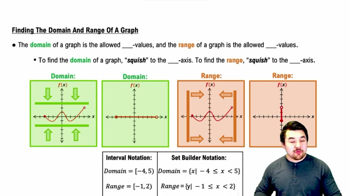
Finding the Domain and Range of a Graph

Reversing Inequalities

When rewriting inequalities, changing a 'greater than' (>) to a 'less than' (<) or vice versa involves flipping the direction of the inequality symbol. This concept is fundamental to correctly transforming statements without altering their truth.
Recommended video:
5:10
Finding the Domain and Range of a Graph

Contextual Application of Inequalities

Applying inequalities in different contexts, such as numerical comparisons or algebraic expressions, requires careful attention to the direction of the inequality. This ensures accurate interpretation and rewriting of statements as instructed.
Recommended video:
5:10
Finding the Domain and Range of a Graph