Overview
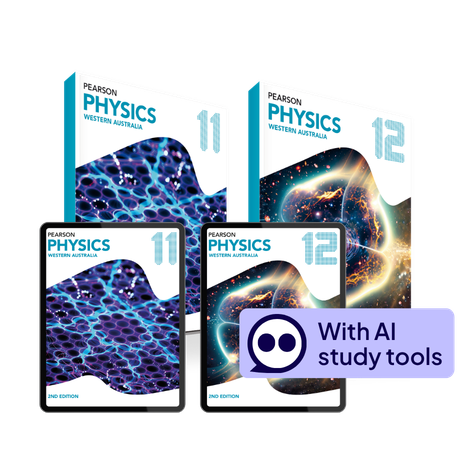
Pearson Physics Western Australia has been updated to support educators implementing the new Physics ATAR Course Syllabus, for implementation from 2024 (Year 11) and 2025 (Year 12).
-
Year Levels 11–12
-
Curriculum WA
-
Subject Science
-
Resource Formats Print, Digital
-
Learning Focus Physics
-
Last Updated May 2025
What it is
Developed by leading Western Australian educators, Pearson Physics WA 2nd Edition is fully aligned to the Physics ATAR Course Syllabus. It helps you prepare students in Years 11 and 12 for a future in science with:
- in-depth student books
- interactive eBooks with AI study tools
- a suite of teaching resources.
What it includes
New Second Edition
Overview
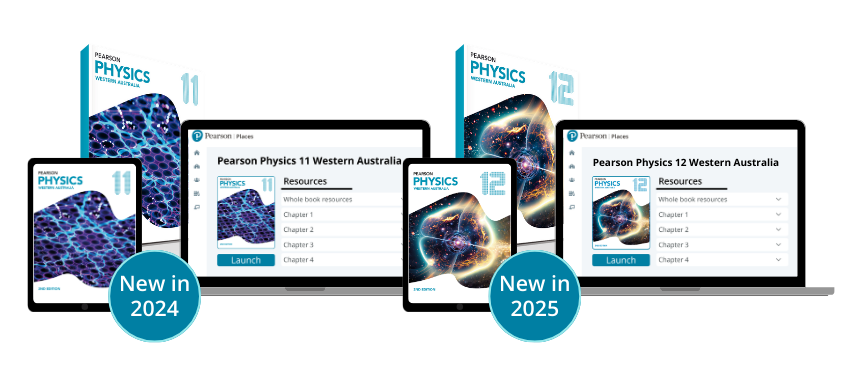
Pearson Physics 2nd edition has been carefully updated for the new Western Australian syllabus, for implementation from 2024 (Year 11) and 2025 (Year 12).
Trusted by teachers, Pearson Physics 2nd edition Western Australia can be used alongside the Science Teachers’ Association of Western Australia (STAWA) Exploring Physics: Experiments, Investigations and Problems Second Edition. Together they ensure full coverage of the required Science Inquiry Skills, Science as a Human Endeavour and Science Understanding content mandated by the syllabus.
Teachers are supported with teaching programs that link these resources in a coherent and effective way.
Components
Student Books
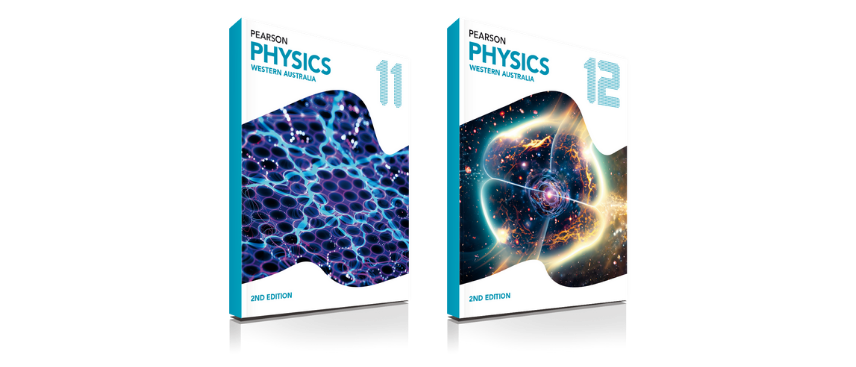
The Student Book has been meticulously revised for the new Physics ATAR course syllabus, and reflects the very latest developments and applications of Physics.
Based in Western Australia, the author team brings extensive experience interpreting, teaching and writing to the Physics ATAR syllabus.
The text has been developed following best-practice literacy and instructional design principles to ensure the content and concepts are accessible to your students.
Components
Student eBooks and digital resources
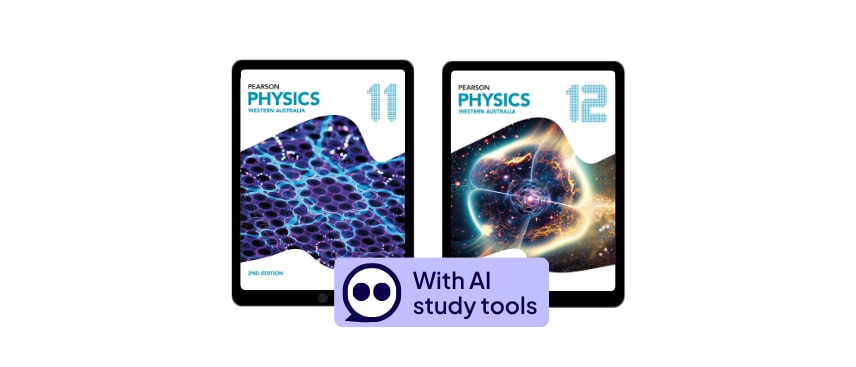
The eBook provides access to Student Book content and digital resources, anywhere, anytime, online and offline.
Student eBook access includes:
- Fully worked solutions to all questions and worked examples in the student book
- Carefully selected, captivating videos that support each chapter
- A downloadable glossary of terms
- Support for Mathematical skills for Physics ATAR.
NEW in 2026
Alongside expert support from teachers, integrated AI study tools provide secure and personalised in-the-moment support drawing only from trusted Pearson eBook content. From their eBooks, students can use AI study tools to:
- highlight concepts for explanations
- summarise chapters
- generate practice questions
- save notes or flashcards.
Components
Teacher eBooks and digital resources
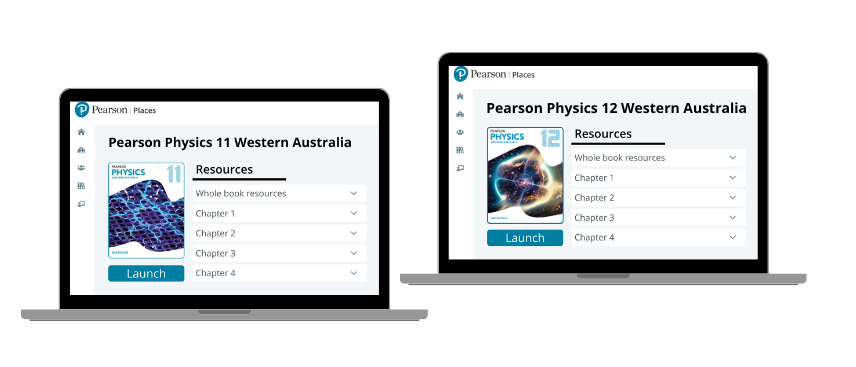
Teacher eBook access includes:
- Downloadable, editable chapter tests and practice exams, supported by fully worked solutions and a formula and data booklet, updated in line with Physics ATAR examination design brief requirements
- Editable teaching programs for each unit which map the Pearson resources to the syllabus and provide clear links to STAWA’s Exploring Physics resources. The teaching programs can be used as a quick guide to the course or as templates for your own planning
- Access to all student resources.
Table of contents
Pearson Physics 11 Western Australia, 2nd Edition
CHAPTER 1 Practical investigation
1.1 Designing and planning the investigation
1.2 Conducting investigations, and recording and presenting data
1.3 Discussing investigations and drawing evidence-based conclusions
Chapter review
UNIT 1 Motion, forces and energy
MOTION AND FORCES
CHAPTER 2 Scalars and vectors
2.1 Scalars and vectors
2.2 Adding vectors in one and two dimensions
2.3 Subtracting vectors in one and two dimensions
2.4 Vector components
Chapter review
CHAPTER 3 Linear motion xx
3.1 Displacement, speed and velocity
3.2 Acceleration
3.3 Graphing position, velocity and acceleration over time
3.4 Equations for uniform acceleration
3.5 Vertical motion
Chapter review
CHAPTER 4 Momentum and forces
4.1 Momentum and conservation of momentum
4.2 Newton’s first law
4.3 Newton’s second law
4.4 Newton’s third law
4.5 Change in momentum and impulse
4.6 Impulse and force
4.7 Mass and weight
Chapter review
Mechanical and thermal energy
CHAPTER 5 Work, energy and power
5.1 Energy and work
5.2 Kinetic energy
5.3 Gravitational potential energy
5.4 Law of conservation of energy
5.5 Elastic and inelastic collisions
5.6 Power
Chapter review
CHAPTER 6 Heating processes
6.1 Heat and temperature
6.2 Specific heat capacity
6.3 Latent heat
6.4 Heating and cooling
Chapter review
Unit 1 Review
UNIT 2 Waves, nuclear and electrical physics
Waves
CHAPTER 7 The nature of waves
7.1 Longitudinal and transverse waves
7.2 Representing waves
7.3 Wave behaviours—reflection, refraction and diffraction
7.4 Wave interactions—superposition, interference and resonance
7.5 Standing waves and harmonics
7.6 Applications of wave properties
Chapter review
Ionising radiation and nuclear reactions
CHAPTER 8 Particles in the nucleus
8.1 Atoms, isotopes and radioisotopes
8.2 Radioactivity
8.3 Properties of alpha, beta and gamma radiation
8.4 Half-life and decay series
8.5 Radiation doses and effects on humans
Chapter review
CHAPTER 9 Fission and fusion
9.1 Nuclear fission and energy
9.2 Chain reactions and nuclear reactors 96
9.3 Nuclear fusion
Chapter review
Electrical forces and energy
CHAPTER 10 Electrical physics
10.1 Behaviour of charged particles
10.2 Energy in electric circuits
10.3 Electric current and circuits
10.4 Resistance
10.5 Series and parallel circuits
10.6 Electrical safety
Unit 2 Review
APPENDIX A SI units
APPENDIX B Understanding measurement
APPENDIX C Mathematical skills for physics ATAR
ANSWERS
GLOSSARY
INDEX
ATTRIBUTIONS
Table of contents
Pearson Physics 12 Western Australia, 2nd Edition
CHAPTER 1 Practical investigation
1.1 Designing and planning the investigation
1.2 Conducting investigations, and recording and presenting data
1.3 Discussing investigations and drawing evidence-based conclusions
Chapter review
UNIT 3 Gravity and relativity
STATIC EQUILIBRIUM AND CENTRE OF MASS
Chapter 2 Equilibrium of forces
2.1 Torque
2.2 Equilibrium of forces
2.3 Static equilibrium
Chapter 2 Review
CIRCULAR MOTION IN HORIZONTAL AND VERTICAL PLANE
Chapter 3 Circular motion
3.1 Circular motion in a horizontal plane
3.2 Circular motion on banked tracks
3.3 Circular motion in a vertical plane
Chapter 3 Review
GRAVITY
Chapter 4 The force due to gravity
4.1 Newton’s law of universal gravitation
4.2 Gravitational fields
4.3 Work in a gravitational field
4.1 Inclined planes
4.2 Projectiles launched horizontally
4.3 Projectiles launched obliquely
4.7 Satellite motion
Chapter 4 Review
RELATIVITY
Chapter 5 Special relativity
5.1 Einstein’s theory of special relativity
5.2 Time dilation
5.3 Length contraction
Chapter 5 Review
Unit 3 Review
UNIT 4 Electromagnetism and modern physics
ELECTROMAGNETISM
Chapter 6 Electric fields
6.1 Electric fields [TBC]
6.2 Coulomb’s law
6.3 Work done in an electric field
Chapter 6 Review
Chapter 7 Magnetic field and force
7.1 The magnetic field
7.2 Forces on charged objects
7.3 The force on a conductor
Chapter 7 Review
Chapter 8 Magnetic field and emf
8.1 Induced emf in a conductor moving in a magnetic field
8.2 Induced emf from a changing magnetic flux
8.3 Transforming voltage using changing magnetic field
8.4 Lenz’s law
Chapter 8 Review
PARTICLE ACCELERATORS
Chapter 9 Particle accelerators
9.1 Particle accelerators
9.2 Relativistic momentum and energy
Chapter 9 Review
WAVE PARTICLE DUALITY AND THE QUANTUM THEORY
Chapter 10 Wave–particle duality and the quantum theory
10.1 Properties of waves in two dimensions
10.2 Interference: Further evidence for the wave model of light
10.3 Electromagnetic waves
10.4 Light quanta: Blackbody radiation and the photoelectric effect
10.5 Atomic spectra
10.6 The quantum nature of light and matter
Chapter 10 Review
COSMOLOGY
Chapter 11 Cosmology
11.1 Expansion of the universe
Chapter 11 Review
Unit 4 Review
APPENDIX A SI units
APPENDIX B Understanding measurement
APPENDIX C Mathematical skills for physics ATAR
ANSWERS
GLOSSARY
INDEX
ATTRIBUTIONS

In partnership with
The Science Teachers' Association of Western Australia (STAWA)
STAWA is a not-for-profit organisation that supports and advocates for science teachers.
STAWA have developed the Exploring Physics books for Year 11 and 12, which include practical experiments and problems that are designed to be used alongside Pearson’s Physics for Western Australia student books and resources.
Used together, Exploring Physics: Experiments, Investigations and Problems and Pearson Physics Western Australia 2nd edition provide a complete package of support for the Science Inquiry Skills, Science as a Human Endeavour and Science Understanding strands
Samples & downloads
Tools and materials to help you unlock Pearson Physics Western Australia.
- Pearson Physics WA 2e—Flyer Download PDF (598KB)
- Pearson Physics Western Australia 11 — Student Book + Solutions — Chapter 2 — Sample Pages Download PDF (31.7MB)
- Pearson Physics Western Australia 11 — Student Book + Solutions — Chapter 3 — Sample Pages Download PDF (4MB)
- Pearson Physics Western Australia 12 — Student Book — Chapter 1 Practical Investigation — Sample Pages Download PDF (2.7MB)
- Pearson Physics Western Australia 12 — Student Book — Chapter 3 Equilibrium of Forces — Sample Pages Download PDF (7.3MB)
Product Information
View resource titles, ISBNs and pricing for Pearson Physics Western Australia 2nd Edition
| Title | ISBN | Price (AUD) |
| Pearson Physics 11 Western Australia 2nd edition Student Book and eBook | 9780655719113 | $99.95 |
| Pearson Physics 11 Western Australia 2nd edition eBook | 9780655719090 | $63.95 |
| Pearson Physics 12 Western Australia 2nd edition Student Book and eBook | 9780655719120 | $99.95 |
| Pearson Physics 12 Western Australia 2nd edition eBook | 9780655719106 | $63.95 |
More for Science in Western Australia
 Updated Oct 2025
Pearson Science 7–10 Western Australia for the Western Australian Curriculum: Science
Everything you need to teach the Western Australian Curriculum: Science. Empowering every teacher, engaging every learner and helping you do more, every day.
