Ch. 2 - Limits and Continuity
Hass - Thomas' Calculus 15th Edition
Hass15th EditionThomas' CalculusISBN: 9780137616077Not the one you use?Change textbook
Chapter 2, Problem 4e

Limits and Continuity


Suppose the functions ƒ(x) and g(x) are defined for all x and that lim (x → 0) ƒ(x) = 1/2 and lim (x → 0) g(x) = √2. Find the limits as x → 0 of the following functions.


e. x + ƒ(x)

Verified step by step guidance
1
Understand that the limit of a sum of functions as x approaches a certain value is the sum of the limits of those functions. This is a fundamental property of limits.
Identify the individual limits given in the problem: lim (x → 0) ƒ(x) = 1/2 and lim (x → 0) g(x) = √2.
Recognize that the function in question is x + ƒ(x). We need to find lim (x → 0) [x + ƒ(x)].
Apply the property of limits: lim (x → 0) [x + ƒ(x)] = lim (x → 0) x + lim (x → 0) ƒ(x).
Since lim (x → 0) x = 0 (as x approaches 0, the value of x itself approaches 0), combine this with the given limit of ƒ(x) to find the overall limit: lim (x → 0) [x + ƒ(x)] = 0 + 1/2.

Verified video answer for a similar problem:

This video solution was recommended by our tutors as helpful for the problem above.
Video duration:
1m
Was this helpful?

Key Concepts

Here are the essential concepts you must grasp in order to answer the question correctly.

Limits

Limits are fundamental in calculus, representing the value that a function approaches as the input approaches a certain point. In this context, understanding how to evaluate limits as x approaches 0 for the functions ƒ(x) and g(x) is crucial. The limit helps determine the behavior of functions near specific points, which is essential for solving the given problem.
Recommended video:
05:50
One-Sided Limits

Continuity

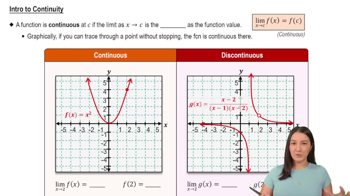
A function is continuous at a point if the limit of the function as it approaches that point equals the function's value at that point. This concept is important when analyzing the behavior of ƒ(x) and g(x) as x approaches 0. Continuity ensures that small changes in x result in small changes in the function's output, allowing for straightforward limit evaluation.
Recommended video:
05:34
Intro to Continuity

Algebra of Limits

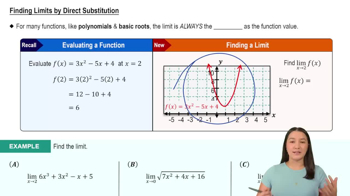
The algebra of limits refers to the rules that govern how limits can be combined, such as the sum, difference, product, and quotient of limits. In this problem, knowing that the limit of a sum is the sum of the limits allows us to find the limit of the function x + ƒ(x) as x approaches 0 by simply adding the limits of x and ƒ(x). This principle simplifies the process of finding limits for more complex functions.
Recommended video:
05:21
Finding Limits by Direct Substitution