Ch. 8 - Integration Techniques
Briggs - Calculus: Early Transcendentals 3rd Edition
Briggs3rd EditionCalculus: Early TranscendentalsISBN: 9780136847243Not the one you use?Change textbook
Chapter 8, Problem 8.5.60

23-64. Integration Evaluate the following integrals.
60.∫ 1/[(y² + 1)(y² + 2)] dy

Verified step by step guidance
1
Recognize that the integral involves a rational function with quadratic factors in the denominator: \(\int \frac{1}{(y^{2} + 1)(y^{2} + 2)} \, dy\).
Use the method of partial fraction decomposition to express the integrand as a sum of simpler fractions. Assume a form: \(\frac{1}{(y^{2} + 1)(y^{2} + 2)} = \frac{A y + B}{y^{2} + 1} + \frac{C y + D}{y^{2} + 2}\), where \(A\), \(B\), \(C\), and \(D\) are constants to be determined.
Multiply both sides of the equation by \((y^{2} + 1)(y^{2} + 2)\) to clear the denominators, resulting in an identity involving polynomials: \(1 = (A y + B)(y^{2} + 2) + (C y + D)(y^{2} + 1)\).
Expand the right-hand side and collect like terms by powers of \(y\). Equate the coefficients of corresponding powers of \(y\) on both sides to form a system of equations for \(A\), \(B\), \(C\), and \(D\).
Solve the system of equations to find the values of \(A\), \(B\), \(C\), and \(D\). Then rewrite the integral as the sum of two simpler integrals, each involving terms like \(\int \frac{y}{y^{2} + a} \, dy\) or \(\int \frac{1}{y^{2} + a} \, dy\), which can be integrated using standard formulas.

Verified video answer for a similar problem:

This video solution was recommended by our tutors as helpful for the problem above.
Video duration:
6m
Was this helpful?

Key Concepts

Here are the essential concepts you must grasp in order to answer the question correctly.

Partial Fraction Decomposition

Partial fraction decomposition is a technique used to break down complex rational functions into simpler fractions that are easier to integrate. For integrals involving products of quadratic terms, expressing the integrand as a sum of simpler rational expressions allows straightforward integration.
Recommended video:
10:07
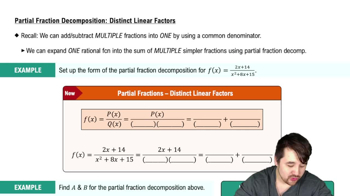
Partial Fraction Decomposition: Distinct Linear Factors

Integration of Rational Functions with Quadratic Denominators

Integrating rational functions with quadratic denominators often involves recognizing standard integral forms, such as arctangent functions. When denominators are irreducible quadratics, the integral typically results in logarithmic or inverse trigonometric functions.
Recommended video:
06:11
Limits of Rational Functions: Denominator = 0

Substitution Method in Integration

The substitution method simplifies integrals by changing variables to transform the integral into a more familiar form. In this problem, after partial fraction decomposition, substitution may be used to integrate terms involving expressions like 1/(y² + a²).
Recommended video:
07:33
Euler's Method
Related Practice
Textbook Question

73. Two methods Evaluate ∫ dx/(x² - 1), for x > 1, in two ways: using partial fractions and a trigonometric substitution. Reconcile your two answers.

64
views

Textbook Question

54–57. {Use of Tech} Comparing the Midpoint and Trapezoid Rules Compare the errors in the Midpoint and Trapezoid Rules with n = 4, 8, 16, and 32 subintervals when they are applied to the following integrals (with their exact values given).

59. ∫(from 0 to π) ln(5 + 3cosx) dx = π ln(9/2)

87
views
Textbook Question

79. Tabular integration extended Refer to Exercise 77.

a. The following table shows the method of tabular integration applied to

∫ eˣ cos x dx.

Use the table to express ∫ eˣ cos x dx in terms of the sum of functions and an indefinite integral.

b. Solve the equation in part (a) for ∫ eʳ cos z dz.

c. Evaluate ∫ e⁻ᶻ sin 3z dz by applying the idea from parts (a) and (b).

56
views
Textbook Question

5–16. Set up the appropriate form of the partial fraction decomposition for the following expressions. Do not find the values of the unknown constants.

6. (4x + 1)/(4x² - 1)

55
views
Textbook Question

85. Another form of ∫ sec x dx

a. Verify the identity:

sec x = cos x / (1 - sin² x)

b. Use the identity in part (a) to verify that:

∫ sec x dx = (1/2) ln |(1 + sin x)/(1 - sin x)| + C

42
views
Textbook Question

42-47. Volumes of Solids Find the volume of the solid generated when the given region is revolved as described.

42. The region bounded by f(x) = ln(x), y = 1, and the coordinate axes is revolved about the x-axis.

80
views