Find all points on the curve y = tan x, −π/2 < x < π/2, where the tangent line is parallel to the line y = 2x. Sketch the curve and tangent lines together, labeling each with its equation.
Ch. 3 - Derivatives
Chapter 3, Problem 3.3.6
Derivative Calculations
In Exercises 1–12, find the first and second derivatives.
y = x³/3 + x²/2 + x/4
Verified step by step guidance1
Step 1: Identify the function for which you need to find the derivatives. The given function is \( y = \frac{x^3}{3} + \frac{x^2}{2} + \frac{x}{4} \).
Step 2: To find the first derivative, apply the power rule to each term of the function. The power rule states that the derivative of \( x^n \) is \( nx^{n-1} \).
Step 3: Differentiate each term separately: \( \frac{d}{dx} \left( \frac{x^3}{3} \right) = x^2 \), \( \frac{d}{dx} \left( \frac{x^2}{2} \right) = x \), and \( \frac{d}{dx} \left( \frac{x}{4} \right) = \frac{1}{4} \). Combine these results to get the first derivative.
Step 4: To find the second derivative, differentiate the first derivative. Apply the power rule again to each term of the first derivative.
Step 5: Differentiate each term of the first derivative: \( \frac{d}{dx} (x^2) = 2x \), \( \frac{d}{dx} (x) = 1 \), and \( \frac{d}{dx} \left( \frac{1}{4} \right) = 0 \). Combine these results to get the second derivative.

Verified video answer for a similar problem:
This video solution was recommended by our tutors as helpful for the problem above.
Video duration:
2mWas this helpful?
Key Concepts
Here are the essential concepts you must grasp in order to answer the question correctly.
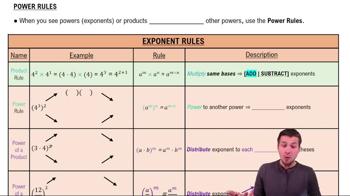
Power Rule for Derivatives
The power rule is a basic principle in calculus used to find the derivative of a function of the form f(x) = x^n. The rule states that the derivative, f'(x), is n*x^(n-1). This rule simplifies the process of differentiation, allowing us to easily find the rate of change of polynomial functions.
Recommended video:
Guided course
Power Rules
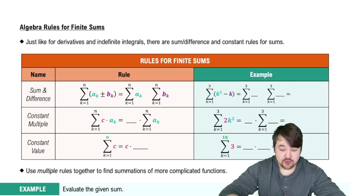
Sum Rule for Derivatives
The sum rule for derivatives states that the derivative of a sum of functions is the sum of their derivatives. If you have a function y = f(x) + g(x), the derivative y' is f'(x) + g'(x). This rule allows us to differentiate each term in a polynomial separately and then combine the results.
Recommended video:
Algebra Rules for Finite Sums
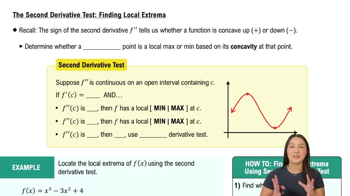
Second Derivative
The second derivative of a function is the derivative of the first derivative, providing information about the curvature or concavity of the original function. It is denoted as f''(x) or d²y/dx². Calculating the second derivative helps in understanding the acceleration or the rate of change of the rate of change of the function.
Recommended video:
The Second Derivative Test: Finding Local Extrema
Related Practice
Textbook Question
255
views
Textbook Question
Derivatives in Differential Form
In Exercises 17–28, find dy.
y = cos(x²)
173
views
Textbook Question
Derivative of multiples Does knowing that a function g(t) is differentiable at t = 7 tell you anything about the differentiability of the function 3g at t = 7? Give reasons for your answer.
172
views
Textbook Question
In Exercises 41–44, determine whether the piecewise-defined function is differentiable at x = 0.
g(x) = { 2x − x³ − 1, x ≥ 0
x − (1 / (x + 1)), x < 0
306
views
Textbook Question
In Exercises 5–10, find an equation for the tangent line to the curve at the given point. Then sketch the curve and tangent line together.
y = (1 / x²), (−1, 1)
209
views
Textbook Question
Slopes and Tangent Lines
In Exercises 1–4, use the grid and a straight edge to make a rough estimate of the slope of the curve (in y-units per x-unit) at the points P₁ and P₂.
256
views