Ch. 4 - Applications of the Derivative
Briggs - Calculus: Early Transcendentals 3rd Edition
Briggs3rd EditionCalculus: Early TranscendentalsISBN: 9780136847243Not the one you use?Change textbook
Chapter 4, Problem 81b

{Use of Tech} Optimal boxes Imagine a lidless box with height h and a square base whose sides have length x. The box must have a volume of 125 ft³.


b. Based on your graph in part (a), estimate the value of x that produces the box with a minimum surface area.  

Verified step by step guidance
1
Step 1: Start by expressing the volume of the box in terms of x and h. Since the box has a square base, the volume V is given by V = x^2 * h. We know the volume is 125 ft³, so we have the equation x^2 * h = 125.
Step 2: Solve the equation from Step 1 for h in terms of x. This gives h = 125 / x^2.
Step 3: Write the formula for the surface area S of the box. Since the box is lidless, the surface area is the area of the base plus the area of the four sides. This is given by S = x^2 + 4xh.
Step 4: Substitute the expression for h from Step 2 into the surface area formula from Step 3. This gives S = x^2 + 4x(125 / x^2).
Step 5: Simplify the expression for S obtained in Step 4. This results in S = x^2 + 500/x. To find the value of x that minimizes the surface area, you would take the derivative of S with respect to x, set it to zero, and solve for x.

Verified video answer for a similar problem:

This video solution was recommended by our tutors as helpful for the problem above.
Video duration:
8m
Was this helpful?

Key Concepts

Here are the essential concepts you must grasp in order to answer the question correctly.

Volume of a Box

The volume of a box is calculated by multiplying its height by the area of its base. For a box with a square base of side length x and height h, the volume V is given by the formula V = x²h. In this problem, the volume is fixed at 125 ft³, which establishes a relationship between x and h that must be maintained while optimizing for surface area.
Recommended video:
08:29
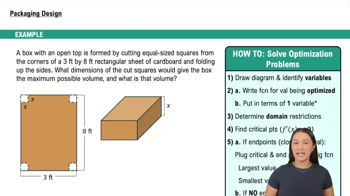
Example 5: Packaging Design

Surface Area of a Box

The surface area of a box is the total area of all its faces. For a lidless box with a square base, the surface area S can be expressed as S = x² + 4xh, where x² is the area of the base and 4xh accounts for the four vertical sides. Minimizing the surface area while maintaining a constant volume is a key aspect of this optimization problem.
Recommended video:
09:07
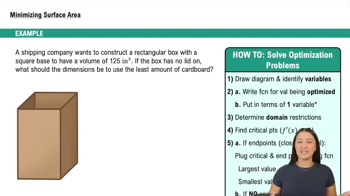
Example 1: Minimizing Surface Area

Optimization in Calculus

Optimization involves finding the maximum or minimum values of a function. In this context, we use calculus techniques such as taking derivatives to find critical points where the surface area is minimized, subject to the constraint of a fixed volume. This often involves setting up a function for surface area in terms of a single variable and applying the first and second derivative tests to identify optimal dimensions.
Recommended video:
10:13
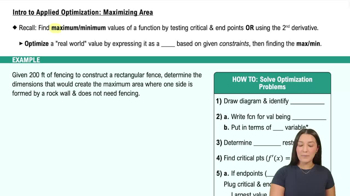
Intro to Applied Optimization: Maximizing Area