Ch. 3 - Derivatives
Briggs - Calculus: Early Transcendentals 3rd Edition
Briggs3rd EditionCalculus: Early TranscendentalsISBN: 9780136847243Not the one you use?Change textbook
Chapter 3, Problem 3.11.7a

The volume V of a sphere of radius r changes over time t.
a. Find an equation relating dV/dt to dr/dt.

Verified step by step guidance
1
Start with the formula for the volume of a sphere: V = (4/3)πr^3.
Differentiate both sides of the equation with respect to time t to find the rate of change of volume with respect to time, dV/dt.
Apply the chain rule to differentiate the right side: dV/dt = d/dt[(4/3)πr^3] = (4/3)π * 3r^2 * (dr/dt).
Simplify the expression: dV/dt = 4πr^2 * (dr/dt).
This equation shows that the rate of change of the volume of the sphere with respect to time, dV/dt, is related to the rate of change of the radius with respect to time, dr/dt, by the factor 4πr^2.

Verified video answer for a similar problem:

This video solution was recommended by our tutors as helpful for the problem above.
Video duration:
3m
Was this helpful?

Key Concepts

Here are the essential concepts you must grasp in order to answer the question correctly.

Related Rates

Related rates involve finding the rate at which one quantity changes in relation to another. In this context, we are interested in how the volume of a sphere changes with respect to time as the radius changes. By applying the chain rule, we can relate the rates of change of volume and radius.
Recommended video:
04:16
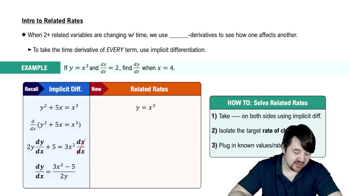
Intro To Related Rates

Volume of a Sphere

The volume V of a sphere is given by the formula V = (4/3)πr³, where r is the radius. This formula is essential for deriving the relationship between the volume and the radius. Understanding how volume depends on radius is crucial for applying calculus to find the rate of change of volume with respect to time.
Recommended video:
08:29
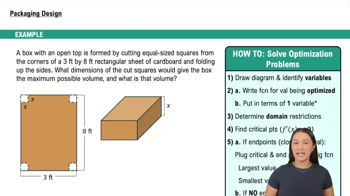
Example 5: Packaging Design

Chain Rule

The chain rule is a fundamental principle in calculus used to differentiate composite functions. In this problem, we apply the chain rule to express dV/dt in terms of dr/dt. This allows us to find how the volume's rate of change is influenced by the radius's rate of change, linking the two quantities effectively.
Recommended video:
05:02
Intro to the Chain Rule
Related Practice
Textbook Question

45–50. Tangent lines Carry out the following steps. <IMAGE>

a. Verify that the given point lies on the curve.

x³+y³=2xy; (1, 1)

290
views

Textbook Question

7–14. Find the derivative the following ways:

a. Using the Product Rule (Exercises 7–10) or the Quotient Rule (Exercises 11–14). Simplify your result.

f(w) = w³ -w / w

238
views
Textbook Question

Tracking a dive A biologist standing at the bottom of an 80-foot vertical cliff watches a peregrine falcon dive from the top of the cliff at a 45° angle from the horizontal (see figure). <IMAGE>


a. Express the angle of elevation θ from the biologist to the falcon as a function of the height h of the bird above the ground. (Hint: The vertical distance between the top of the cliff and the falcon is 80−h.)

266
views
Textbook Question

Airline travel The following figure shows the position function of an airliner on an out-and-back trip from Seattle to Minneapolis, where s = f(t) is the number of ground miles from Seattle t hours after take-off at 6:00 A.M. The plane returns to Seattle 8.5 hours later at 2:30 P.M. <IMAGE>

a. Calculate the average velocity of the airliner during the first 1.5 hours of the trip (0 ≤ t ≤ 1.5).

302
views
Textbook Question

{Use of Tech} Approximating derivatives Assuming the limit exists, the definition of the derivative f′(a) = lim h→0 f(a + h) − f(a) / h implies that if ℎ is small, then an approximation to f′(a) is given by

f' (a) ≈ f(a+h) - f(a) / h. If ℎ > 0 , then this approximation is called a forward difference quotient; if ℎ < 0 , it is a backward difference quotient. As shown in the following exercises, these formulas are used to approximate f′ at a point when f is a complicated function or when f is represented by a set of data points. <IMAGE>

Let f (x) = √x.

a. Find the exact value of f' (4).

245
views
Textbook Question

13-26 Implicit differentiation Carry out the following steps.

a. Use implicit differentiation to find dy/dx.

sin y = 5x⁴−5; (1, π)

237
views