Use the Leading Coefficient Test to determine the end behavior of the graph of the polynomial function.
Ch. 3 - Polynomial and Rational Functions

Chapter 4, Problem 24
Divide using synthetic division. (x5+4x4−3x2+2x+3)÷(x−3)
Verified step by step guidance1
Identify the divisor and rewrite it in the form \(x - c\). Here, the divisor is \(x - 3\), so \(c = 3\).
Write down the coefficients of the dividend polynomial \(x^{5} + 4x^{4} + 0x^{3} - 3x^{2} + 2x + 3\). Note that the \(x^{3}\) term is missing, so its coefficient is 0. The coefficients are: \([1, 4, 0, -3, 2, 3]\).
Set up the synthetic division by writing \(c = 3\) to the left and the coefficients in a row to the right.
Bring down the first coefficient (1) as it is. Then multiply it by \(c\) (3) and write the result under the next coefficient. Add the column and write the sum below. Repeat this multiply-and-add process for all coefficients.
After completing the process, the last number you get is the remainder. The other numbers form the coefficients of the quotient polynomial, which will be of degree one less than the original polynomial (degree 4 in this case).

Verified video answer for a similar problem:
This video solution was recommended by our tutors as helpful for the problem above.
Video duration:
5mWas this helpful?
Key Concepts
Here are the essential concepts you must grasp in order to answer the question correctly.
Synthetic Division
Synthetic division is a shortcut method for dividing a polynomial by a linear binomial of the form (x - c). It simplifies the long division process by using only the coefficients of the polynomial, making calculations faster and less error-prone.
Recommended video:
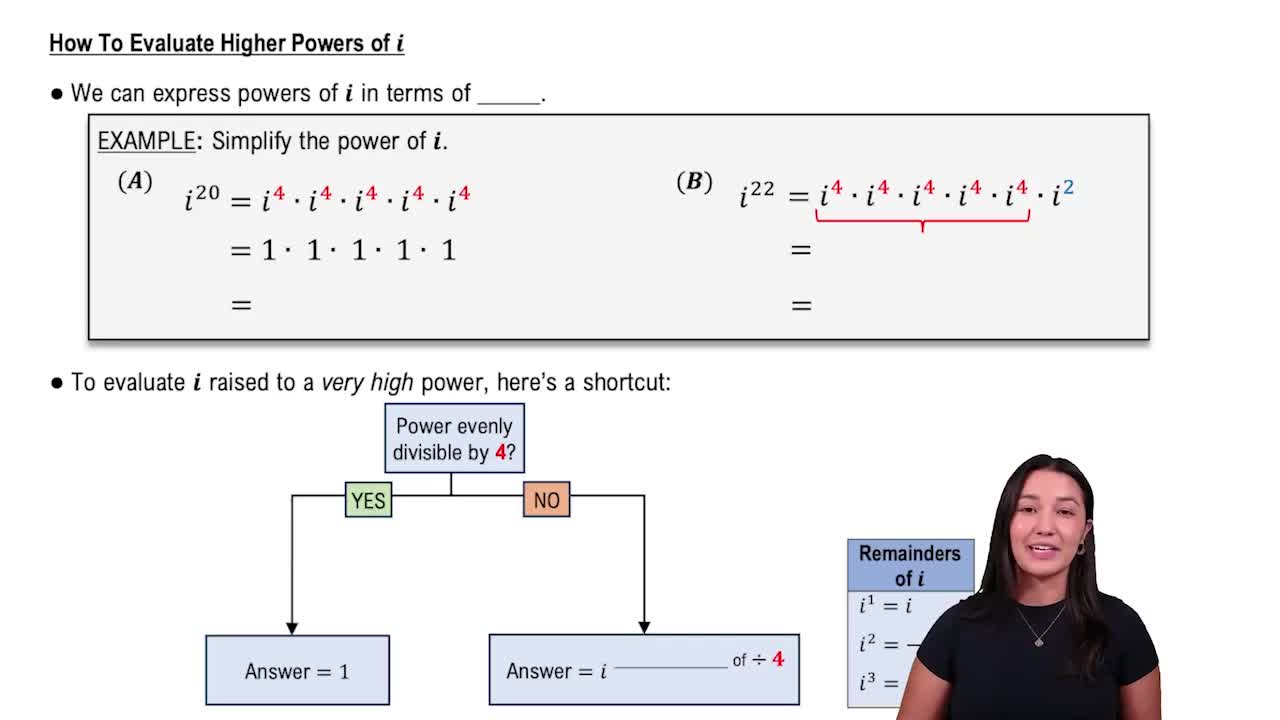
Higher Powers of i
Polynomial Coefficients and Missing Terms
When performing synthetic division, it is important to include coefficients for all powers of x, even if some terms are missing. For example, if the polynomial lacks an x³ term, its coefficient is zero, which must be included to maintain proper alignment during division.
Recommended video:
Guided course
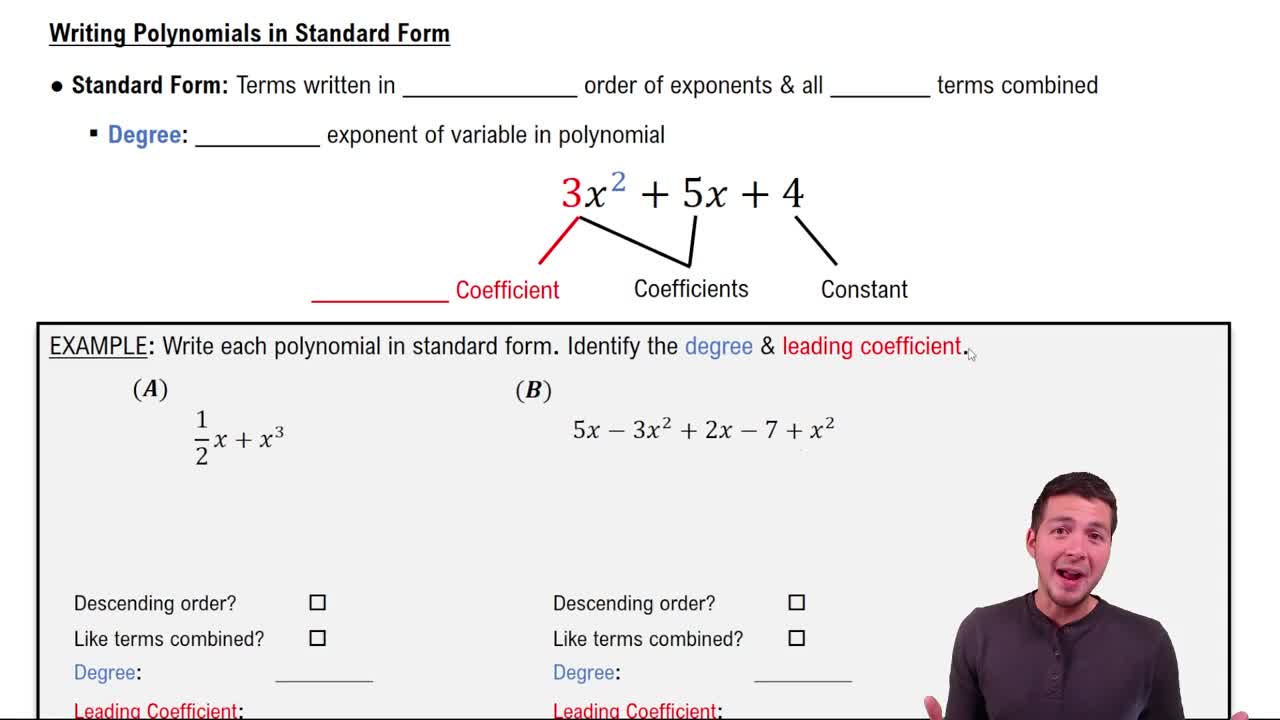
Standard Form of Polynomials
Remainder and Quotient Interpretation
The result of synthetic division provides a quotient polynomial and a remainder. The quotient has one degree less than the original polynomial, and the remainder is a constant. Understanding how to interpret these results is essential for solving division problems and further factorization.
Recommended video:
Product, Quotient, and Power Rules of Logs
Related Practice
Textbook Question
1950
views
Textbook Question
Use the vertex and intercepts to sketch the graph of each quadratic function. Give the equation of the parabola's axis of symmetry. Use the graph to determine the function's domain and range. f(x)=4−(x−1)2
1101
views
Textbook Question
Solve each polynomial inequality in Exercises 1–42 and graph the solution set on a real number line. Express each solution set in interval notation. −x2 + 2x ≥ 0
516
views
Textbook Question
Divide using synthetic division. (6x5−2x3+4x2−3x+1)÷(x−2)
479
views
Textbook Question
In Exercises 19–24, use the Leading Coefficient Test to determine the end behavior of the graph of the polynomial function.
638
views
Textbook Question
Find the vertical asymptotes, if any, and the values of x corresponding to holes, if any, of the graph of each rational function. h(x)=x/x(x+4)
642
views