Ch. 4 - Exponential and Logarithmic Functions
Blitzer - College Algebra 8th Edition
Blitzer8th EditionCollege AlgebraISBN: 9780136970514Not the one you use?Change textbook
Chapter 5, Problem 39

In Exercises 39–40, graph f and g in the same rectangular coordinate system. Use transformations of the graph of f to obtain the graph of g. Graph and give equations of all asymptotes. Use the graphs to determine each function's domain and range. f(x) = log x and g(x) = - log (x+3)

Verified step by step guidance
1
Identify the base function f(x) = \(\log\) x, which is the logarithmic function with vertical asymptote at x = 0 and domain (0, \(\infty\)). Its range is all real numbers (-\(\infty\), \(\infty\)).
Analyze the function g(x) = -\(\log\)(x+3). Notice that the argument of the logarithm is (x + 3), which means the graph of f(x) is shifted horizontally to the left by 3 units. This changes the vertical asymptote from x = 0 to x = -3.
The negative sign in front of the logarithm reflects the graph of f(x) across the x-axis. So, after shifting the graph of f(x) left by 3 units, reflect it over the x-axis to get g(x).
Write the equation of the vertical asymptote for g(x) as x = -3, since the logarithm is undefined when its argument is zero, i.e., x + 3 = 0.
Determine the domain and range of g(x): the domain is all x such that x + 3 > 0, or x > -3, and the range remains all real numbers (-\(\infty\), \(\infty\)) because reflection and horizontal shifts do not restrict the range of the logarithmic function.

Verified video answer for a similar problem:

This video solution was recommended by our tutors as helpful for the problem above.
Video duration:
13m
Was this helpful?

Key Concepts

Here are the essential concepts you must grasp in order to answer the question correctly.

Logarithmic Functions and Their Graphs

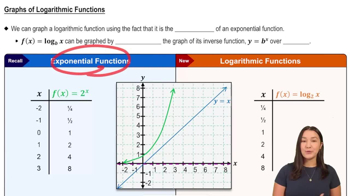
A logarithmic function, such as f(x) = log x, is the inverse of an exponential function. Its graph passes through (1,0) and has a vertical asymptote at x = 0. The function is defined only for positive x-values, and its range is all real numbers.
Recommended video:
5:26
Graphs of Logarithmic Functions

Transformations of Functions

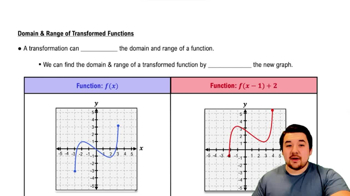
Transformations include shifts, reflections, and stretches/compressions of a graph. For g(x) = -log(x+3), the graph of f(x) = log x is shifted left by 3 units and reflected across the x-axis. Understanding these helps in sketching g(x) from f(x) and identifying changes in domain and range.
Recommended video:
4:22
Domain & Range of Transformed Functions

Asymptotes and Domain/Range of Logarithmic Functions

Logarithmic functions have vertical asymptotes where the argument equals zero. For f(x) = log x, the asymptote is x = 0; for g(x) = -log(x+3), it is x = -3. The domain excludes these values, while the range remains all real numbers. Recognizing asymptotes is key to understanding function behavior.
Recommended video:
5:26
Graphs of Logarithmic Functions
Related Practice
Textbook Question

Solve each exponential equation in Exercises 23–48. Express the solution set in terms of natural logarithms or common logarithms. Then use a calculator to obtain a decimal approximation, correct to two decimal places, for the solution. 7(x+2)=410

770
views
Textbook Question

Use properties of logarithms to expand each logarithmic expression as much as possible. Where possible, evaluate logarithmic expressions without using a calculator. ln(x3x2+1(x+1)4)\(\ln\) \(\left\)( \(\frac{x^3 \sqrt{x^2 + 1}\)}{(x + 1)^4} \(\right\))

981
views
Textbook Question

The figure shows the graph of f(x) = ex. In Exercises 35-46, use transformations of this graph to graph each function. Be sure to give equations of the asymptotes. Use the graphs to determine graphs. each function's domain and range. If applicable, use a graphing utility to confirm your hand-drawn h(x) = ex-1+2

781
views
Textbook Question

Use properties of logarithms to expand each logarithmic expression as much as possible. Where possible, evaluate logarithmic expressions without using a calculator. log(10x21x37(x+1)2)\(\log\) \(\left\)( \(\frac{10x^2 \sqrt[3]{1 - x}\)}{7(x + 1)^2} \(\right\))

917
views
Textbook Question

The figure shows the graph of f(x) = ex. In Exercises 35-46, use transformations of this graph to graph each function. Be sure to give equations of the asymptotes. Use the graphs to determine graphs. each function's domain and range. If applicable, use a graphing utility to confirm your hand-drawn g(x) = ex+2

890
views
Textbook Question

Solve each exponential equation in Exercises 23–48. Express the solution set in terms of natural logarithms or common logarithms. Then use a calculator to obtain a decimal approximation, correct to two decimal places, for the solution. 70.3x=813

778
views