Ch. 3 - Polynomial and Rational Functions
Blitzer - College Algebra 8th Edition
Blitzer8th EditionCollege AlgebraISBN: 9780136970514Not the one you use?Change textbook
Chapter 4, Problem 5

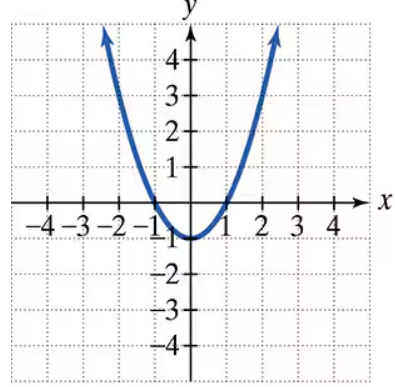
The graph of a quadratic function is given. Write the function's equation, selecting from the following options.
f(x)=x2+2x+1g(x)=x22x+1f(x) = x^2 + 2x + 1 \(\quad\) g(x) = x^2 - 2x + 1
h(x)=x21j(x)=x21h(x) = x^2 - 1 \(\quad\) j(x) = -x^2 - 1
Graph of an upward-opening parabola with vertex at (-1, 0) on a Cartesian plane with labeled axes.

Verified step by step guidance
1
Identify the general form of a quadratic function, which is \(y = ax^2 + bx + c\).
Use the point where the graph crosses the y-axis, which is \((0, 9)\), to find the value of \(c\). Since \(x=0\), the equation simplifies to \(y = c\), so \(c = 9\).
Substitute the other given point \((-3, 18)\) into the equation \(y = ax^2 + bx + 9\) to create an equation involving \(a\) and \(b\): \$18 = a(-3)^2 + b(-3) + 9$.
Simplify the equation from the previous step to get \$18 = 9a - 3b + 9\(, then rearrange it to \)9 = 9a - 3b$.
Use the vertex or symmetry of the parabola (if known) or another point to create a second equation to solve for \(a\) and \(b\). Alternatively, analyze the shape and direction of the parabola to determine the signs and values of \(a\) and \(b\).

Verified video answer for a similar problem:

This video solution was recommended by our tutors as helpful for the problem above.
Video duration:
2m
Was this helpful?

Key Concepts

Here are the essential concepts you must grasp in order to answer the question correctly.

Quadratic Function and Its Standard Form

A quadratic function is a polynomial of degree two, typically written as f(x) = ax^2 + bx + c. The graph of a quadratic function is a parabola, which can open upwards or downwards depending on the sign of 'a'. Understanding the standard form helps in identifying the coefficients that define the shape and position of the parabola.
Recommended video:
04:34
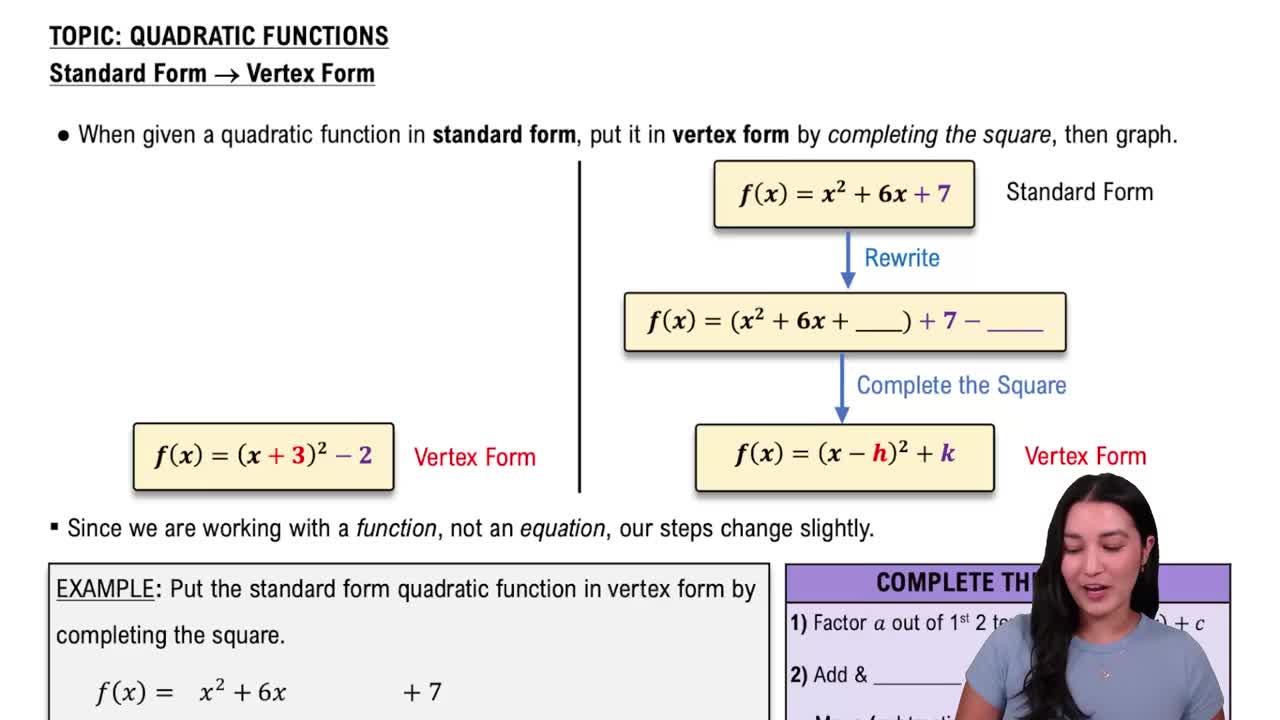
Converting Standard Form to Vertex Form

Using Points to Determine the Equation

Given points on the graph, such as (-3, 18) and (0, 9), you can substitute these coordinates into the quadratic equation to form a system of equations. Solving this system allows you to find the values of a, b, and c, which define the specific quadratic function that fits the graph.
Recommended video:
Guided course
4:36
Determinants of 2×2 Matrices

Interpreting the Vertex and Y-Intercept

The vertex of the parabola is its highest or lowest point, and the y-intercept is where the graph crosses the y-axis (x=0). In this graph, the point (0, 9) is the y-intercept, giving the value of c directly. Recognizing these points simplifies finding the quadratic equation.
Recommended video:
08:07
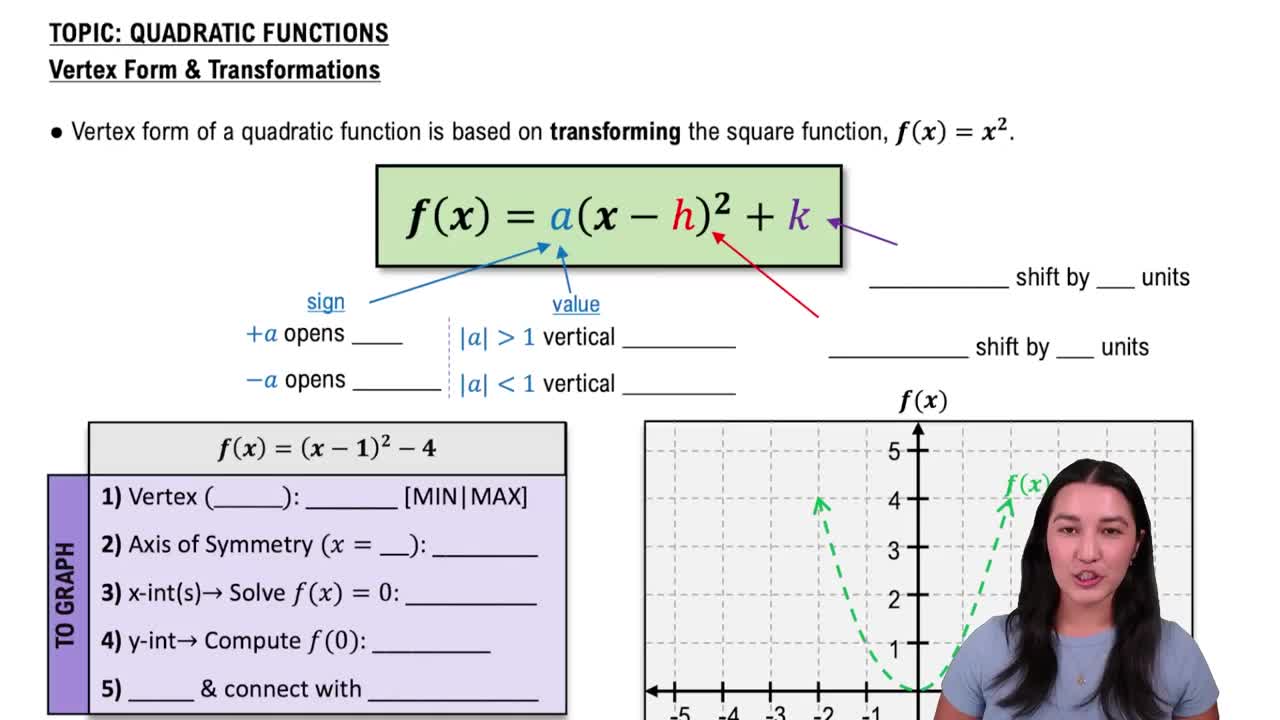
Vertex Form