Ch. R - Review of Basic Concepts
Lial - College Algebra 13th Edition
Lial13th EditionCollege AlgebraISBN: 9780136881063Not the one you use?Change textbook
Chapter 1, Problem 31

If the expression is in exponential form, write it in radical form and evaluate if possible. If it is in radical form, write it in exponential form. Assume all variables represent positive real numbers. ⁵√ k²

Verified step by step guidance
1
Identify the given expression: the fifth root of \( k^2 \), which is written as \( \sqrt[5]{k^2} \). This is in radical form.
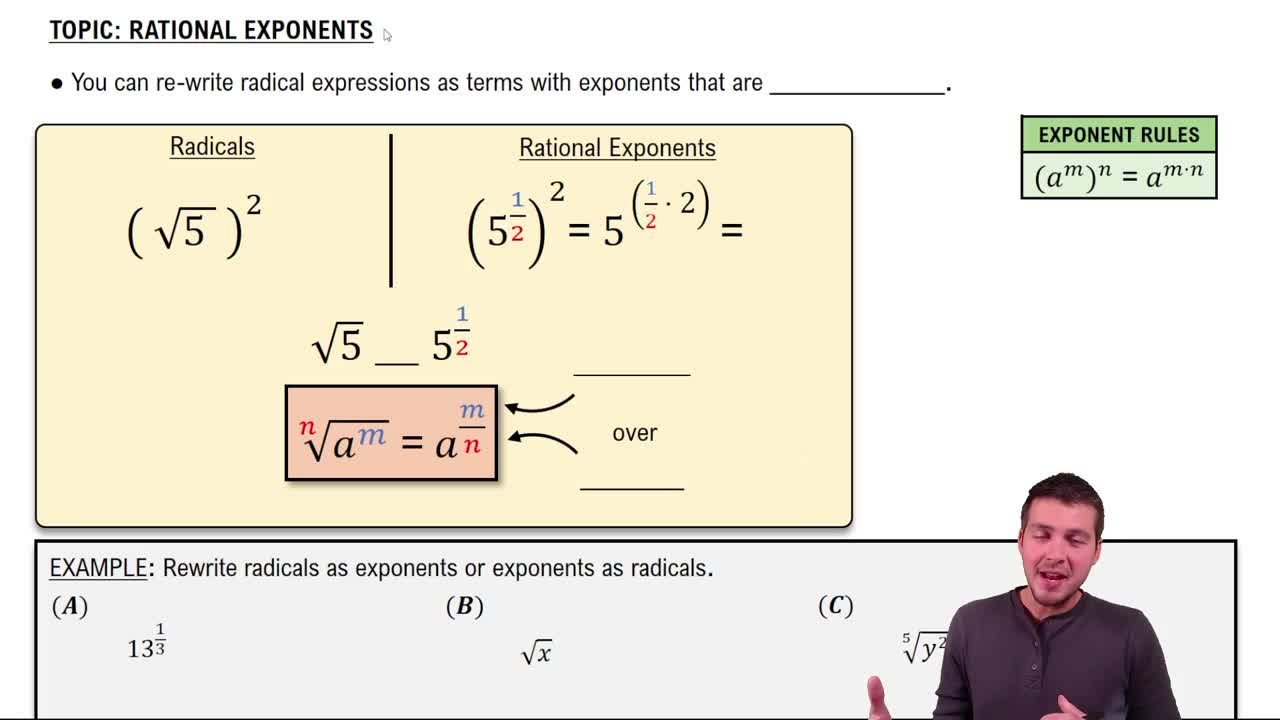
Recall the relationship between radicals and exponents: \( \sqrt[n]{a^m} = a^{\frac{m}{n}} \). This means the \( n \)-th root of \( a^m \) can be written as \( a \) raised to the power \( \frac{m}{n} \).
Apply this rule to the expression \( \sqrt[5]{k^2} \) by rewriting it as \( k^{\frac{2}{5}} \). This converts the radical form into exponential form.
Since the problem asks to evaluate if possible and variables represent positive real numbers, note that \( k^{\frac{2}{5}} \) is already simplified and cannot be further evaluated without a specific value for \( k \).
Summarize: the radical expression \( \sqrt[5]{k^2} \) is equivalent to the exponential expression \( k^{\frac{2}{5}} \).

Verified video answer for a similar problem:

This video solution was recommended by our tutors as helpful for the problem above.
Video duration:
1m
Was this helpful?

Key Concepts

Here are the essential concepts you must grasp in order to answer the question correctly.

Exponential and Radical Forms

Exponential form expresses roots using fractional exponents, where the nth root of a number is written as that number raised to the power of 1/n. For example, the fifth root of k squared, ⁵√(k²), can be written as k^(2/5). Understanding this equivalence allows conversion between radical and exponential expressions.
Recommended video:
Guided course
05:20
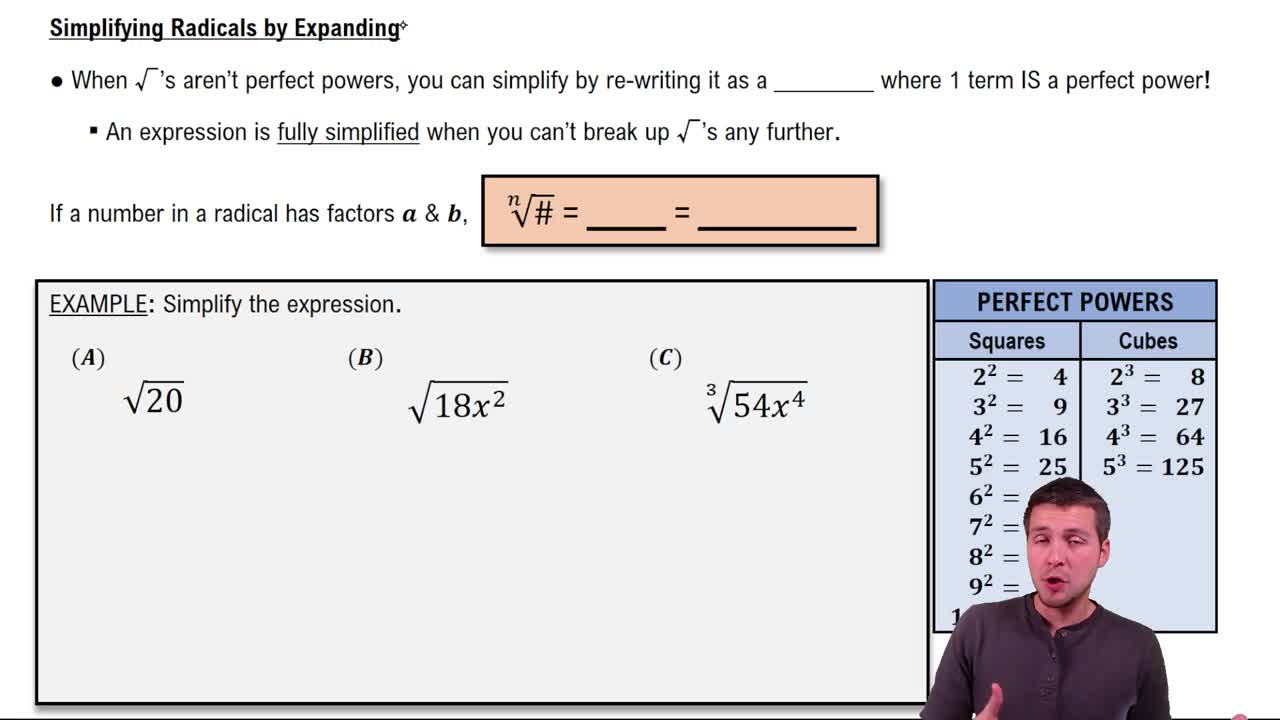
Expanding Radicals

Properties of Exponents

Properties of exponents govern how to manipulate expressions with powers, including multiplying, dividing, and raising powers to powers. For fractional exponents, these properties help simplify expressions and evaluate them when possible, such as rewriting k^(2/5) or simplifying powers of variables.
Recommended video:
Guided course
04:06
Rational Exponents

Assumption of Positive Real Numbers

Assuming variables represent positive real numbers ensures that roots and fractional exponents are defined and real-valued. This assumption avoids complications with negative bases or complex numbers, allowing straightforward conversion between radical and exponential forms without considering absolute values or complex results.
Recommended video:
03:31
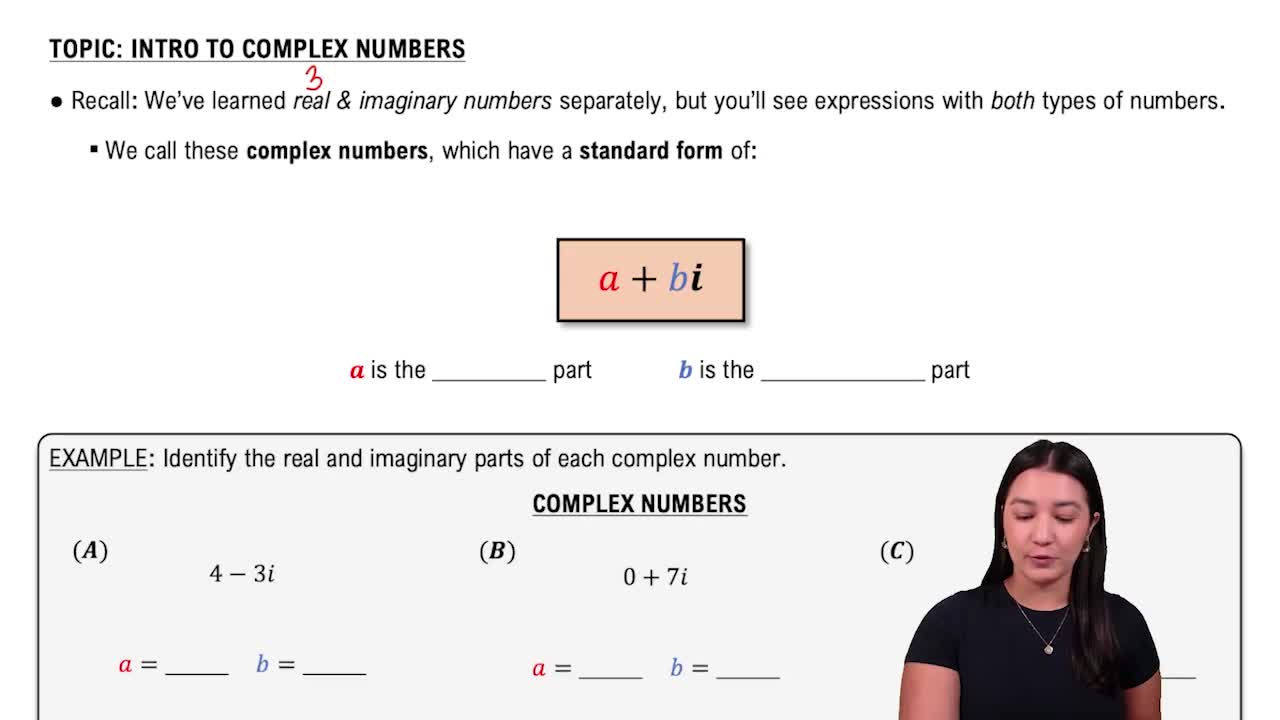
Introduction to Complex Numbers