Ch. 19 - Amines
Wade - Organic Chemistry 9th Edition
Wade9th EditionOrganic ChemistryISBN: 9780135213728Not the one you use?Change textbook
Chapter 19, Problem 4

Which of the amines listed next is resolved into enantiomers? In each case, explain why interconversion of the enantiomers does or does not take place.
(a) cis-2-methylcyclohexanamine 
(b) N-ethyl-N-methylcyclohexanamine 
(c) N-methylaziridine 
(d) ethylmethylanilinium iodide
(e) methylethylpropylisopropylammoniumiodide

Verified step by step guidance
1
Step 1: Understand the concept of chirality in amines. Amines can be chiral if they have a stereogenic center, such as a nitrogen atom bonded to four different groups. However, due to the rapid inversion of the nitrogen's lone pair (known as nitrogen inversion), most amines cannot be resolved into enantiomers unless the inversion is restricted.
Step 2: Analyze (a) cis-2-methylcyclohexanamine. The nitrogen atom in this compound is bonded to a hydrogen atom, a methyl group, and the cyclohexane ring. However, due to nitrogen inversion, the enantiomers interconvert rapidly, making it impossible to resolve this compound into enantiomers.
Step 3: Analyze (b) N-ethyl-N-methylcyclohexanamine. The nitrogen atom here is bonded to an ethyl group, a methyl group, and the cyclohexane ring. Similar to (a), nitrogen inversion occurs, leading to rapid interconversion of enantiomers, so this compound cannot be resolved into enantiomers.
Step 4: Analyze (c) N-methylaziridine. The nitrogen atom in this compound is part of a strained three-membered aziridine ring. The ring strain restricts nitrogen inversion, preventing the interconversion of enantiomers. Therefore, this compound can be resolved into enantiomers.
Step 5: Analyze (d) ethylmethylanilinium iodide and (e) methylethylpropylisopropylammonium iodide. Both are quaternary ammonium salts, meaning the nitrogen atom is bonded to four different groups and carries a positive charge. Since quaternary ammonium salts do not undergo nitrogen inversion, both compounds can be resolved into enantiomers.

Verified video answer for a similar problem:

This video solution was recommended by our tutors as helpful for the problem above.
Video duration:
5m
Was this helpful?

Key Concepts

Here are the essential concepts you must grasp in order to answer the question correctly.

Chirality

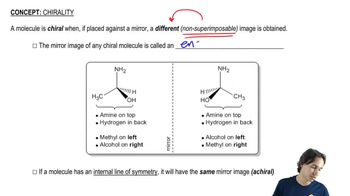
Chirality refers to the geometric property of a molecule that makes it non-superimposable on its mirror image, much like left and right hands. A chiral molecule typically has at least one carbon atom bonded to four different substituents, leading to the existence of two enantiomers. Understanding chirality is crucial for determining whether a compound can exist as enantiomers and how they interact with polarized light.
Recommended video:
05:10
What is chirality?

Enantiomer Interconversion

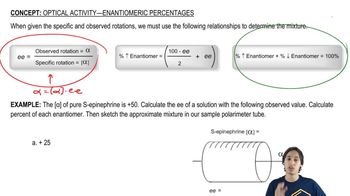
Enantiomer interconversion is the process by which one enantiomer is transformed into its mirror image. This can occur through various mechanisms, such as rotation around a single bond or through a reaction that breaks and reforms bonds. The ability of enantiomers to interconvert affects their stability and the conditions under which they can be separated or exist in equilibrium.
Recommended video:
03:23
How to solve for the percentage of each enantiomer.

Amines and Stereochemistry

Amines are organic compounds derived from ammonia by replacing one or more hydrogen atoms with alkyl or aryl groups. The stereochemistry of amines can be complex, especially when they contain chiral centers or are part of cyclic structures. Understanding the stereochemical implications of amines is essential for predicting their behavior, including whether they can form enantiomers and how their structure influences their reactivity.
Recommended video:
Guided course
1:38
Polymer Stereochemistry Concept 1